PART ONE
- 2.1 Back to the Lubyanka
- 2.2 The deathless KGB
- 2.3 In the Belly of the Beast
- 2.4 A Drunken Wedding Party
- 2.5 It’s an ill wind …
- 2.6 All rise, the court is in session!
SOURCES
*
Judgement in Moscow (online)
*
“The night after battle belongs to the looters”
(Popular saying)
This pile of documents fell into my hands by chance.
After months of fruitless endeavour, I already despaired of ever seeing a thing. The euphoria that followed the failed putsch of August 1991 had evaporated. Hopes of rapid change were fading, not just for the rebirth of Russia but for some remotely sensible or decent outcome. The return to power of those who ran the country under the Communists was in full swing. I had all but decided not to visit Moscow anymore: why agonize needlessly over the sight of its hopeless squalor?
Yet there was no peace for me back home in Cambridge. The old, familiar world was changing before my eyes. For no obvious reason it, too, began to collapse, as though struck by the forces of entropy unleashed by immense structures disintegrating in the East. A mighty hand, it seemed, had removed the invisible fulcrum of our lives, robbing them of meaning and support. After dominating the world for two centuries, the idea of an earthly utopia was in its death throes. Its demise was inevitable and desirable, as all instinctively knew, but, fearful of the unknown, people would not abandon it. Utterly dismayed, they remained rooted to the spot. Only the “intellectual elite”, with suicidal determination, clung to the shards of its now absurd ideal. Like a centipede with a broken back, it wriggled and jerked, but its movements lacked coordination: a mythical “New World Order”, “the global village”, a “federal Europe”, “ecologists”, “feminists”, defenders of animal and plant rights… And, inevitably, people offered shameless justification of their behaviour during the Cold War. It was sheer madness. What I most feared had happened: a cowardly refusal to fight led to an inability to recover. The inhuman Utopia had fallen, but neither freedom of spirit nor nobility of thought arose from the ruins. There was nothing but an absurd, pathetic farce. The many millions of victims had died in vain: humanity did not emerge better, wiser, and more mature…
For Russia, the result was a shoddy tragicomedy. Second-rate Party bosses, KGB generals even, claimed the role of leading democrats and saviours of the country from communism. The most ugly, rotten and vile creatures who, thanks to a total withering of conscience, survived in the dark corners of the system, now took centre stage. In Soviet criminal jargon, they were “jackals“. As long as there were real criminals in the prison cell, the jackals huddled, unseen and unheard, on the floor under the lowest bunk. When the hardened offenders were marched off to the camps, the jackals emerged and began throwing their weight around – until another real criminal appeared, and they dived back out of sight.
Observing this “jackals’ democracy” I could not help recalling Vladimir Vysotsky’s prophetic words (“’Where are you, Wolves?’ Hunting by Helicopter”):
I live. But I’m surrounded
By beasts, to whom the wolf’s cry is unknown.
They’re dogs, our distant kindred,
Whom we regarded as our prey.
Yet an old and ingrained habit of never giving up compelled me to keep going back to Russia, whatever common sense might say. After all, we had devoted our entire lives to a “quite hopeless cause”. What else could I do? Gritting my teeth and choking back my revulsion, I kept shuttling back and forth, trying to meet the country’s new “democratic” leadership and persuade them to open the Party archives. The longer it continued, the harder it became to abandon my goal, although the chances of success diminished with every visit.
*
2.1 Back to the Lubyanka
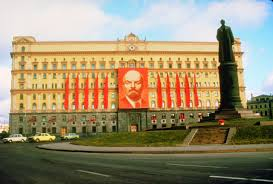
KGB headquarters (pre-1991)
The putsch of 19-21 August 1991 had hardly ended when I returned to Moscow to prove to the new masters of Russia’s destiny that it was in their interests to open the archives. A wounded beast of prey must be given no chance to recover. It is essential, I told them, to set up a commission to investigate all the crimes of Communism, and preferably an international commission so there could be no accusations of political bias or cover-ups. The case against the “putschists” should be expanded into a trial of the CPSU. It must be conducted openly, without delay, in the full glare of publicity and before the television cameras, just like Congressional hearings in the USA.
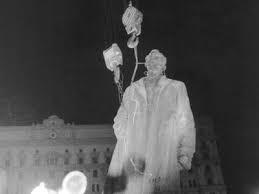
It was a unique moment, everything seemed possible. In disarray, the nomenklatura (administrative and managerial elite of the Soviet Union), fearing kangaroo courts and public lynching, was agreeable to anything. The sight of Felix Dzerzhinsky’s statue hanging in a noose above its pedestal on Lubyanka Square made their blood run cold. In such circumstances, it would have been quite feasible to convene, if not a Nuremberg-style tribunal, then something very similar which could have exercised a yet stronger moral influence on our degenerate world. The most extraordinary thing is that it almost happened. Intoxicated by its unexpected victory, the Russian leadership did not look very far ahead, and knew nothing of the outside world. The prospect of finishing off the Communist Party, its closest rival, seemed both logical and attractive.
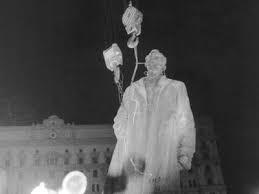
Dzerzhinsky statue, 1991
*
“You know,” I was told, “it’s really not a bad idea. But it shouldn’t proceed from us, that’s all, not from the government. You should set the ball rolling.”
I agreed. The new chairman of the State Television and Radio Company, Yegor Yakovlev was hastily summoned, and he thought of a most sensational way to open the discussion: I would hold a televised dialogue with Vadim Bakatin, who had just been appointed head of the KGB. It was early September 1991 and Moscow had not yet recovered from the putsch. Barricades still stood around the “White House”, and flowers lay on the Garden Ring at the spot where three young men had died, when Yakovlev, myself and a film crew drove to the notorious building on the Lubyanka.
Everything was as in my youth: the Children’s World (Detsky Mir) department store on the corner and the grim KGB headquarters dominating the square, opposite the metro station; only the empty pedestal of “Iron Felix”, founder of the Cheka, bore witness to recent events. It was strange to see that pedestal covered with graffiti (“Down with the CPSU!”) and with drawings of the Communist hammer and sickle linked by an equal’s sign to the Nazi swastika. Removed each night by someone’s caring hand, these slogans reappeared every day. This went on for several weeks, until people tired of the game. Then a carefully inscribed text in white paint appeared on the clean pedestal: “Forgive us, Felix, for failing to protect you”. The Chekists had the last word, after all.
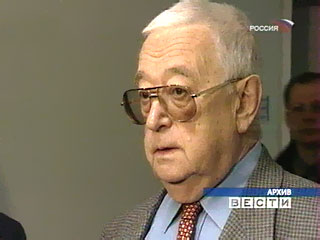
Yegor Yakovlev
The guards at the entrance presented arms. Perhaps this was because we were accompanied by Bakatin’s aide; perhaps it was the standard greeting for “VIP visitors”. Twenty-eight years earlier, I could not help recalling, I was brought here without any such honours, not via the main entrance but through the gates at the rear where the duty sergeant was interested only in the contents of my pockets. A lifetime, if not an entire epoch, had passed between those two visits. Yet the recollection prompted feelings neither of pleasure nor triumph. On the contrary, it gave tangible form to a sense of impotence, that all my efforts had been wasted: “I’ve spent my life fighting this organization,” I thought, “and yet it’s still here. Who can say which of us will outlive the other?”
Naturally, there was good reason for selecting Bakatin as my partner in discussion. His career under Gorbachov had been an unremarkable passage from regional Party secretary to Minister of Internal Affairs but he was reputed to be a determined man who loathed the organisation he now headed. When Gorbachov offered him the KGB chairmanship, immediately after the putsch, at a meeting of the Presidents of the Union Republics, Bakatin first refused, saying that the KGB “should simply be dissolved”.
“We are entrusting you to do just that,” said Yeltsin to Bakatin.
At the time our conversation was filmed, Bakatin had held his new position for little over a week. Yet already he had successfully transferred several services from the KGB to other ministries and as for the nefarious Directorate “Z”, the successor of the 5th Chief Directorate which dealt in political repression, he had closed it down altogether. He was not yet accustomed to his vast new office and seemed rather ill at ease. When I asked who occupied this office before him, he spent some while, like a schoolboy with a new electronic toy, looking for the right button to summon his assistant. As becomes a real Chekist, Bakatin’s aide appeared noiselessly, like a mushroom after rain.
“Tell us the history of this office.”
No, Andropov never sat here. His headquarters had been in another building. The previous tenants of this office were Chebrikov, then Kryuchkov…
*
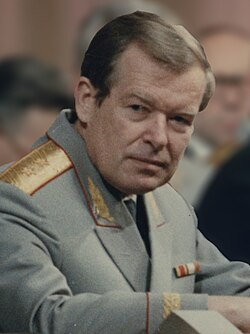
Vadim Bakatin
(1937-2022; 1988 photo)
Bakatin was clearly embarrassed by his new position, by my visit and, especially, by our imminent discussion.
Obviously, he knew the theme in advance and had no need to fear any dirty tricks from my side. But the television cameras, he asked, what would they show? “Full view? Even my socks?” For some reason, the prospect of showing his socks on television seemed to unsettle him the most.
When preparing for our conversation, I had mentally divided it into three parts, three issues, which, by reducing the likely opponents to a minimum, would make it possible to justify the idea of an international commission (first proposed in 1974).
At an earlier press conference, as I already knew, Bakatin had spoken against the public naming of the KGB’s secret informers. I had no objections. In a country where, if not every tenth person was an informer (as in the GDR), then every twentieth assuredly was, it would be impossible and pointless to begin with their exposure. Just as pointless, incidentally, as putting every member of the CPSU on trial. No clear line could be drawn between members and non-members of the Party, between an informer and a Soviet conformist. Except for a handful of “renegades” like ourselves, it was a demoralized and compromised country. What was one supposed to do – set up a new Gulag?
Bearing in mind the purely legal difficulties, the scale of the problem, and the opposition of the informers and their “bosses”, who were now ensconced at every level of the present government, it would be impossible to start with them. In the Czech Republic, the only former communist country with the courage to begin “lustration”, the public reaction was sharply negative, and the process became hopelessly bogged down by the issue of informers. In any case, it would be unnecessary and downright harmful in Russia. The aim was not to single out and punish the more guilty individuals but to achieve a moral cleansing of society. We needed repentance, not the mass hysteria, reprisals, denunciations and suicides, which such an investigation of individuals would invariably provoke. The system as a whole, and all the crimes it perpetrated, must be condemned. It would be quite sufficient to pronounce judgment on its leaders, who were already in prison for organizing the “putsch “.
On this Bakatin and I were in complete agreement, so I deliberately started our conversation with this issue, to demonstrate my support for his position, and set the right tone for the rest of our discussion. It was important to show the millions who watched the programme that, contrary to common belief, former political prisoners and dissidents had no desire for revenge: my proposals were not guided by personal concerns but by far more important principles. Nor was I being two-faced. I truly do not nurture feelings of hatred and have not the slightest wish to be avenged because I was never anyone’s victim – all that happened to me, occurred of my own free choice, in full awareness of the consequences. As for taking revenge against informers, that would be absurd. From those sent to infiltrate our circles or deliberately planted in our prison cells, I knew these people well, unlike the majority of my fellow citizens (including Bakatin). Most informers were pitiful individuals who had been broken and often blackmailed or intimidated into becoming agents for the KGB. No one can know how he will act under such pressure. Those who lack that experience have no right to judge others. Those who have themselves withstood such an ordeal are usually loath to sit in judgment. In this respect, I was prepared to be as lenient as was necessary.
Two other issues called for total implacability.
It was our duty before history, I said, to reveal all the secrets hidden in the archives. That was why it was proposed to convene an international commission made up of prominent Russian and foreign historians. In raising this issue, I deliberately lumped together the 1934 killing of Kirov, the 1963 assassination of John Kennedy and the attempt on the life of Pope John Paul II in 1980 to lead the conversation to my third and last major issue: the international crimes of the CPSU and the KGB. This subject was still taboo in the USSR. The average Soviet citizen was expected to believe that although the Communists were guilty of crimes against their own people, of internal repression and destroying the economy, they were “just like everyone else”, no better or worse, when it came to their dealings with other nations. A la guerre, comme à la guerre. The Americans were no angels, either. As for Intelligence – well, doesn’t every State, including the most democratic, have an Intelligence Service?
Cultivated assiduously by the press and the country’s leaders, this dangerous myth had to be demolished, together with the illusory figure of the heroic and patriotic Soviet “agent”. It must be made perfectly clear that the Soviet Union had no “normal” foreign policy; that which it pursued was nothing less than decades of criminal activity against humanity. That is why I kept this subject to the end, when our discussion was beginning to sound like a conversation between two old friends who were in perfect agreement. Suddenly I began referring to matters unknown to the average viewer: Soviet sponsorship of international terrorism and involvement in the narcotics business; the bribing and blackmailing of foreign politicians, businessmen and cultural figures; and the colossal system of disinformation built up by the KGB abroad. “After all,” I insisted,
“apart from the KGB we have a military intelligence service, the GRU, that really does deal with military matters. That is a separate issue. The KGB is a political body. It has entrapped an enormous number of foreigners, through bribery or blackmail. Believe me, this cannot be ignored. I understand the complexities of dismantling such a system, but it cannot be left as it is. If we do not get rid of it, our country cannot win the trust of others…. We can hardly live as a normal State if this body continues to exist… We have a certain obligation to the international community, moreover, and to other countries to help them rid themselves of the evil which this system has created.”
“Of course,” I cautioned in closing,
“the security of our own State is also affected. Foreign experts, for instance, estimate that in its activities abroad the KGB has amassed such extensive resources through its own banks, front organizations and enterprises that if it were closed down in Moscow it could easily continue to exist and function for at least another ten years. That’s what they say in the West. And, of course, you cannot leave things as they are. It could prove to be your enemy.”
To give Bakatin his due, he did not argue or remonstrate, and when he did answer, he mainly pleaded ignorance. He could hardly do otherwise, being so new to the job. “Espionage is a most difficult subject for me at the moment,” he mumbled. In fact, he had a rather odd way of talking, without punctuation or a clear beginning or end to his sentences. “In this instance, even in my action plans, in my personal calendar, I have set intelligence matters to one side…. I don’t think they have any documents about the criminal activities you mention. If there are some facts, about which I know absolutely nothing, that some of them – I don’t know, it could be that some of them did engage… for example, in the drugs trade or in support for terrorism … If this is so, then it all needs to be considered, dismantled… And this is very serious. We none of us have much idea what they get up to abroad…”
If he was not frightened then, it seemed, he was rather perturbed, especially by what I said about the funds accumulated overseas by the KGB. He kept repeating that he could not let this pass unnoticed, that all this must be confirmed and, most importantly, that he was quite prepared to support my idea:
“In general, in principle, I agree with you: the truth must be uncovered. It must at least be established. But I cannot reach agreement with you, here and now, about the conditions for setting up this international commission,” he said at the end of our discussion. “There are also legal aspects which must be considered…. It was in the interests of our agency to keep this secret, that’s why many did not know. Therefore, such a proposal must be accepted in principle. In principle. We must consider how to go about it.”
“Well, Vadim Victorovich,” I said, extending my hand, “I would like to wish you success, express my sympathy, and shake the hand of the first head of the KGB I have ever met…”
And for a moment, I must confess, I believed it could happen. We would meet again, without the TV cameras, discuss the legal aspects of the situation, outline the tasks ahead and get down to business… Why not? Yeltsin would sign a decree. I would call up my historian friends like Robert Conquest from the Hoover Institution, and the guys from Memorial (16 November 1988*, 1979-K), and whistle up some students from the Russian Archives Institute to help them. Then we would begin to tackle the piles of documents. Everything seemed possible during those days when people equated the hammer and sickle with the swastika on the empty pedestal in Dzerzhinsky (Lubyanka) Square.
For a fleeting moment, I imagined that this simple equation would become what it should always have been for our world, a truth as self-evident as 2+2 = 4. Something small and simple, but how much more honest and untainted our life would be … The next instant the vision was displaced by reality: “How can a pleasant bumbler, so touchingly embarrassed about showing his socks on television, deal with this monster? He’ll have no idea what’s going on behind his back.”
The friend waiting outside summed it up. “It’s people like you, not him, who are needed here,” he commented laconically, almost ruthlessly, as if hammering a nail into a coffin lid.
*
2.2 The deathless KGB
My discussion with Bakatin was shown on 9 September 1991 on the most widely-viewed TV channel in the USSR. It followed immediately after the 9 pm Evening News and was broadcast with just a few minor and unexceptionable editorial cuts. The programme lasted only twenty minutes or so, but it provoked a turbulent reaction.
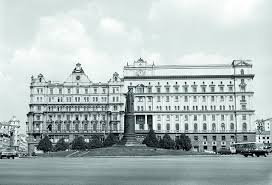
KGB headquarters (early 1980s)
The response of the press, overall, was favourable and emphasis was laid on the “extraordinary” fact of such a dialogue: How the times have changed, how the country has changed! The most popular papers and magazines of that time, the Izvestiya daily newspaper and the Ogonyok magazine, published articles about our discussion, with commentaries in which I tried to develop the subject further: “Interview between a famous dissident and the KGB chairman” (Izvestiya, 10 September 1991) and “Creating a team for a pogrom” (Ogonyok, No 39, 21-28 September 1991). Naturally, some reproached me for being too soft on informers and, especially, for shaking hands with the head of the KGB. I was neither surprised nor upset: in such times, loud mouths and fools are always hyperactive, and it is their favourite pastime to earn political capital with cheap demagogy.
Much more important, my amiable purring did not dull the vigilance of those whom it concerned most closely, the “professionals”. They understood all too well what I was driving at, and my calm and friendly tone probably alarmed them much more than threatening tirades or demands for retribution. A few days later General Shebarshin, then head of the First Directorate, the KGB’s foreign intelligence department, appeared on television. Without mentioning my discussion with Bakatin, he assured viewers – in passing, as it were – that there would be no sensational exposures about the activities of the KGB abroad. This was a signal to “their” people and their numerous “partners” in other countries that there was no cause for concern (e.g., the “Vzglyad” TV programme, 27 September 1991).
Then came a stream of articles by former intelligence officers with “democratic” reputations, intended to show that my impression of the scope of their activities was vastly exaggerated. Retired intelligence officer Mikhail Lyubimov wrote in Ogonyok:
“… even veteran dissident Vladimir Bukovsky, whose knowledge of the KGB is not theoretical, commented in his epoch-making interview with Bakatin that it would be good if our country limited itself to military intelligence, and stopped political and other intelligence-gathering altogether. This is a wise and progressive idea, but I wonder how much support it would gain from Western governments, which, apart from military intelligence organizations, have their CIA, SIS, BND and Mossad. Bukovsky also suggested that the external intelligence arm of the KGB is engaged in massive disinformation operations abroad.”
There followed a detailed denial, of course, that there was any vast disinformation system: just a few pathetic efforts, a handful of forged documents which fooled nobody and “merely provoked anger with their creators” (“Drang nach Westen: a KGB distraction manoeuvre that fooled no one in the West”, Ogonyok, October 1991).
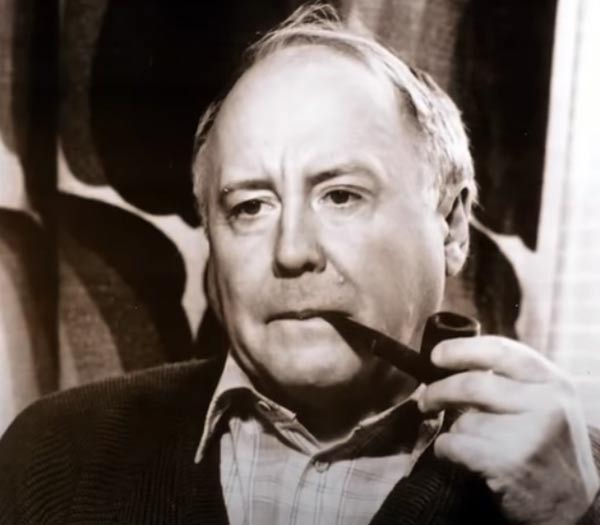
Mikhail Lyubimov
I have enough inside experience of ‘active measures’ to declare that forgeries are a tiny part of intelligence work: the lion’s share is devoted to reworking our propaganda to give it a ‘Western’ gloss… And most of this “work” was mere pin pricks, unnoticed in the great flood of Western information, and contributed nothing to the Soviet foreign policy interests of the time – those vapid and murky policies were doomed and could not be saved either by propaganda or agitation issuing from ‘Western sources’.
In short, there was no system of disinformation, there were no agents of influence and no “forces of peace, progress and socialism”. As if to illustrate this thesis the Russian newspaper Kultura reprinted an article from the Los Angeles Times by a prominent American political scientist (or so it was said), full of standard KGB disinformation about ‘dissidents’ (“Press testimony. A maelstrom of dissidents lost in the wild”, Kultura, 30 November 1991). They were all crazy extremists, and Bukovsky, worse still, “is negotiating with the new head of the KGB, as if someone authorized him to do so, and proposes to destroy the KGB archives so that the names of informers will never be known.” It was hard to say, at first sight, whether this highly respected American gentleman was an agent of influence, or if he had been briefed by one. Kultura was unlikely to subscribe to the Los Angeles Times. Much later, when I tried to find the original publication, it turned out that the American daily had never published such an article. It is still a puzzle – where did it come from?
Soon the First Directorate was transferred hastily from the KGB to the newly formed Foreign Intelligence Service, answerable directly to Gorbachov and headed by his friend Yevgeny Primakov. Naturally, there were far more serious reasons than my televised discussion with Bakatin: first and foremost, there was the danger that all Union-level structures would break down as the USSR disintegrated. There can be no doubt, however, that there was another motive behind this decision: it would protect the foreign intelligence agency from any investigations and reforms, or, in the words of the cloak-and-dagger brigade, help them “get rid of the KGB tail”. They dived for shelter behind the broad back of the President, taking all their secrets with them.
Bakatin had constantly relegated the problem to the back of his “personal calendar” and was probably only too glad to be rid of it. He later made honest efforts, it must be said, to follow up the KGB crimes of which I had told him. But – wonder of wonders! – he could not discover anything of substance. Somehow even remote incidents of only historical interest, such as the Kennedy assassination and the attempt on the life of the Pope, had nothing to do with the poor maligned KGB. It proved impossible to find anything new about the persecution of Solzhenitsyn and Sakharov. Only after lengthy wrangling and denials that any such documents existed, was it suddenly “discovered” that hundreds of KGB files about them had been burnt, supposedly, in 1990. It was beyond Bakatin’s powers to remove the seal of secrecy from the small number of files which did come to light. For instance, the quite innocuous records about the surveillance of Lee Harvey Oswald during his stay in the USSR from 1959 to 1962 were held up by one commission after another before surfacing, suddenly, in the hands of the KGB of the now independent Republic of Belarus. And there they stayed until Bakatin was removed from his post, early in 1992. The KGB officials pretended to know nothing, not caring if anyone believed them or not.
Whether Bakatin realized that he was being played for a sucker, I do not know. His memoirs Getting Rid of the KGB (1992) seemed more than a little naive. They certainly got rid of him fast enough (he served from August to December 1991): the KGB remained. Splitting it up into separate directorates and services, which is what Bakatin tried to do during his hundred and seven days as its head, was as pointless as chopping off a lizard’s tail or dividing an amoeba. The body grew back from the pieces, and increased in numbers, just like the tale in which a new dragon grew from each dragon tooth. Locked behind seven seals, the archives were the heart of the KGB, the soul of the dragon. The only way to vanquish the beast was to pierce its heart. Instead, the hero supposed to accomplish this feat went on a drunken spree.
Straight after the putsch Boris Yeltsin had signed a decree transferring the KGB archives to the Russian archives administration. Now he seemed to lose all interest in this and any other matters of importance to the country. An inter-departmental committee was appointed to handle the transfer, at which KGB personnel gravely discussed the “problems” involved and, not surprisingly, could find no solutions. Another committee was formed at the Supreme Soviet, headed by the general and historian Volkogonov, because there had to be some “legal basis”: how could anything be done “outside the law”? It was no trifling matter to decide whether to set the seal of secrecy at 30 or 70 years. Meanwhile, mysterious “commercial structures” began to grow up around the archives. A brisk trade ensued, but only in documents, the publication of which profited the KGB, and only through partners who suited that organisation. Double-dyed disinformation was again turned loose upon the world, this time under the guise of historical truth…
*
2.3 In the Belly of the Beast
I was neither discouraged nor at a loss what to do. Even before my meeting with Bakatin I had no great expectation of seeing the KGB archives. My attention was focused on the archives of the Party’s Central Committee which, immediately after the putsch, had been sealed together with the Central Committee building on the Old Square (Staraya Ploshchad).
They were, therefore, already in the hands of the Russian government with which I had some contact. Furthermore, I knew that these archives should contain everything, including reports by the KGB which, we were always told, was merely the Party’s “sword of retribution”, its “armed detachment”. In the post-Stalin era, at least, the KGB was under the firm control of the Party and could engage in no significant undertaking without the Central Committee’s approval.
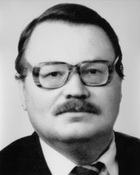
Rudolf Pikhoya
Thanks to my contacts with the Russian leadership, I met the head of the government Archives Committee, Rudolf Pikhoya, within days of arriving in Moscow in August 1991, to establish the conditions under which the future international commission would work. A few days later, with a certain degree of elation and trepidation, I entered the huge complex of Central Committee buildings at 12 Kuibyshev Street (nowadays again known as Ilyinka), where both the archives and the archive administration were housed. The buildings, linked by endless corridors and elevated walkways, seemed dead. The archive administration occupied only one floor. The rest was like the labyrinth of the Minotaur: you could neither enter nor leave without Ariadne’s thread. The superb parquet flooring of the corridors stretched endlessly past sealed doors still bearing the nameplates of their former occupants, once all-powerful apparatchiks. Here and there, lay mounds of files and papers marked “Top Secret”. I picked up one at random and glanced at the contents: it was a report about youth work by a regional Party committee. For a second, I felt a pinch of apprehension: what if there was nothing here but endless reports about the fulfilment of plans and propagandist activities? Moscow had been full of rumours about the mass destruction of documents and mysterious trucks which removed bales of papers several nights in a row after the putsch…
Pikhoya reassured me. Yes, some papers really were destroyed, but they were, seemingly, instructions issued during the “putsch “. The archives themselves, as far as one could judge, had not suffered. The decree ordering the seizure of the Party archives was signed by Yeltsin on 24 August, and the commission with the new guards entered the Central Committee buildings that same night. At first, the electricity supply was cut off to prevent any use of shredding machines, but then it had to be turned on again (it was impossible to find anything in the dark). The shredding machines were already jammed with hurriedly destroyed documents and no longer in working order.
“The first step was to seal the doors to all the offices,” said Pikhoya, “and now we are bringing all the papers from the offices into one large room, where we sort and number them. Nobody can remove anything from here, and, in fact, it is impossible for the old staff to enter the building, even to collect their personal belongings. The guards have all been replaced by cadets from a police academy in Vologda (or Volgograd, was it?)”
The entrances and exits were manned by sturdy young men with submachine guns. We literally stumbled into one of them, a strapping young fellow with a childish, bewildered face, as we turned a corner: “Can you tell me where the canteen is?” he pleaded. “I’ve been wandering around for half an hour and still can’t find it…” The former Central Committee buffet in the basement had survived but lacked any tempting delicacies in short supply. Whatever else the Central Committee staff overlooked at the last moment, it wasn’t a stick or two of salami.
xxx
As experience showed, the selective destruction or, for that matter, the forgery of any material in the Central Committee archives was virtually impossible. This was mainly because, on closer examination, there proved to be at least 162 separate archives, unconnected to one other by cross referencing, card indexes or computers.
The Communist regime trusted nobody, including its own officials. Just to confirm whether any copies of a document from one archive were to be found in another, or if there was a reference in one archive to a document housed elsewhere, would have taken months of searching. If a copy of a document did exist, it would not be that easy to change anything: every archive had its own inventory; the documents were numbered consecutively and had their own codes; and there were separate registers for all incoming and outgoing papers. The bureaucratic State did not stint on paper for these purposes, which is probably why it was always in short supply elsewhere. The archive listing all Party members, the “consolidated Party membership record”, contained no less than 40 million items. As for the Party archives scattered throughout the country, they numbered billions of documents.
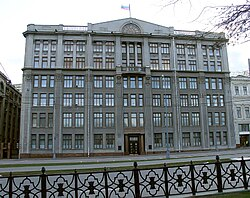
CPSU Central Committee building
With a group of journalists invited by Pikhoya, I went out of curiosity into one of these archives, which contained the dossiers on the Central Committee nomenklatura. The immense room with high, figured ceilings (before the revolution the building had been a bank or an insurance company) was filled with metal stacks on sliding rails. The central control panel, located on a dais at the entrance to the room, had dozens of buttons, pressing which caused the desired stack to shift slowly, exposing shelves covered with dossiers on one individual after another. There were up to a million files, concerning the living and the dead, Politburo members and the ordinary staff of the Central Committee.
This archive soon became a showpiece: it was here that foreigners, journalists and high-ranking visitors were brought to demonstrate the daring and democracy of the new custodians of Party secrets. Journalists were usually shown the files on Voroshilov, Mikoyan and, occasionally, Sholokhov, pulled from the shelves as if at random. This was impressive and harmless. The archive administrators were in no hurry to lay bare its mysteries, let alone to champion their publication. They were not idealistic activists, just typical Soviet bureaucrats who had built their careers under the old regime and, like all slaves, they were cowardly and cunning. Their attitude toward the authorities, their bosses, was a slave’s mixture of fear and hatred, and the more they hated, the more they wanted to cheat their masters in some way. They regarded the unexpected bounty as their personal windfall, to be guarded jealously from all “outsiders”.
The standard bureaucratic types were represented in their midst, just as in any Soviet organisation. One acted the part of the faithful and honest Party member, waging relentless war against “corruption “: he was finally caught selling documents to journalists. Another appeared to be a man of the intelligentsia. He was fond of discussing “our common human values” and talking about our duty to history, though it was known he “allowed” foreign colleagues access to certain secret papers: in return he was invited to speak at international conferences, earning himself a reputation as “a prominent historian”. It never entered their heads that all this was dishonest, shameful or reprehensible. What could one do if Soviet people had no conscience?
Naturally, I was just such an “outsider”, a thief eyeing their riches, from whom they tacitly agreed to protect their “property”. They simply could not understand my motives – what was I after? Was I trying to get a cut for myself? The mere thought of handing this bounty over to humanity without turning a profit seemed as crazy to them as a banker dishing out money on the streets to passers-by. As I had come to them with the permission of their new masters, their initial attitude was predictable: nobody risked an outright refusal (Who knew who might be backing me?), but while they agreed with me, just in case, in every respect, each day they managed to invent new excuses for delay. They claimed we must wait for new legislation to be passed concerning State secrets; the proposal to convene an international commission required approval by the Supreme Soviet; and so on, and so forth. Their main concern was for the matter to be placed in the hands of innumerable Supreme Soviet committees. There it would sink without trace in endless debates conducted by yesterday’s Party bosses, who today were the “elected representatives of the people”.
Finally, I could stand it no longer. Time was pressing and I could wait no more. I had a harsh and candid talk with Pikhoya, explaining that neither he nor his underlings held any copyright on history, nor would they ever do so. He defended himself rather limply, mainly reiterating the need for a “law”, and talking of the 30-year rule governing archives, which was accepted throughout the world – for example, in England. He had no choice, however, and signed our “agreement” with a marked lack of enthusiasm:
“The International Commission to study the activities of Party structures and State Security bodies of the USSR
“1. Archive materials concerning the activities of the CPSU and State security bodies have been made available pursuant to Decrees Nos 82 and 83, signed by the Russian President on 24 August 1991. It is acknowledged that the activities of these organizations were of an international nature and concerned the interests of many countries. Consequently, the efforts of domestic researchers alone would be insufficient to deal with this complex of problems. Moreover, foreign archives contain materials which would be valuable in widening the scope of the study of the history of the above-mentioned organizations. The inclusion of foreign scholars in the investigation would also lend credibility to the findings of the Commission. Because of the above, on the initiative of the Archives Committee of the RSFSR Council of Ministers, the following have agreed to form an international commission for a full and detailed study of the archive materials which have become available:
- The International Archive Council (Paris);
- The Hoover Institution of Peace, War and Revolution (Stanford, California)
- American Enterprise Institute (Washington);
- Research Department of Radio Liberty (Munich);
- Russian University for the Humanities;
- The Memorial Research, Information and Education Centre.
“The Commission will involve foreign and domestic experts in its work on both a temporary and a full-time basis.
“The Commission will not concern itself with current defence matters, will not engage in the pursuit of any individuals because of their former activities, or cause damage to any State whatsoever.
“The aim of the Commission is to carry out a comprehensive and objective study of all the above-mentioned materials and let history be the judge.
“In pursuit of this aim, the Commission reserves the right to draw necessary materials from other document repositories (archives).
“2. Organizational Principles
“The Commission, composed of representatives of the founder organizations listed above, will itself decide all administrative and financial questions.
“Working groups will be organized on the principle of specific activities (thematic, chronological, etc.) with input from invited experts.
“3. Activities
“The founder organizations undertake the financing of the program and will take all necessary steps to ensure the safety of the materials issued for its work.
“The Commission undertakes to use the possible income from publication of the materials to finance its work and to support archival activities.
“As a result of its studies, the Commission proposes to computerize the archive materials and publish them as collections of documents or monographs.
“R.G. Pikhoya
“V.K. Bukovsky
“11 September 1991”
Pikhoya added the underlined phrase in the document by hand, just in case. The Commission might or might not come into being, but the “initiative” must be credited to his Committee. As if to stress: Everything belongs to me, anyway, and I’m the boss around here!
After a month of feverish activity, I flew home with a faint hope that my schemes would bear fruit. There was no final decision, no certainty I could rely on those I had just met, and I had no supporters. Just a sheet of paper with Pikhoya’s signature – and how much was that worth? I had been unable to achieve anything more. In that phantom kingdom, nothing was certain, nothing was final. At any minute, everything might change. Promises made in public were no longer considered binding. Nobody could say for certain who was in power today, let alone tomorrow. No one had any idea what decision the authorities might take. It felt as if a person existed only so long as you clutched him by the sleeve. The minute you let go, he disappeared: one moment he was there, the next moment he was gone. The only person who gave an impression of permanence in that situation was Yeltsin.
“Now it’s all up to President Yeltsin,” I told journalists before my departure. “As soon as he gives the go-ahead, we’ll start work.” (See Marina Mulina, “Give the documents to the historians and bin the denunciations”, Sobesednik, No 39, 1991.)
*
Chapter 2: Night of the Looters (part two) …
================================================

