- 2.1 Back to the Lubyanka
- 2.2 The deathless KGB
- 2.3 In the Belly of the Beast
PART TWO
- 2.4 A Drunken Wedding Party
- 2.5 It’s an ill wind …
- 2.6 All rise, the court is in session!
SOURCES
*
Judgement in Moscow (online)
*
2.4 A Drunken Wedding Party
However, time passed and things got no better. The Russian leadership was paralyzed, as though it had expended all its energy during the three days of the putsch. It is a fact, unique in history, that Yeltsin did absolutely nothing during his first hundred days in power. For a while he dropped out of sight completely: some said that he was on a drinking spree, others that he had gone off somewhere to recuperate. When he reappeared, he was unable to devise a program of action or set specific goals. First Yeltsin started reshuffling the old bureaucratic pack of cards, which only made it swell in size. Then he and his whole entourage were suddenly off to the Caucasus, to reconcile the Armenians and the Azeris. One day he would proclaim a state of emergency in Chechnya and then rescind it the next.
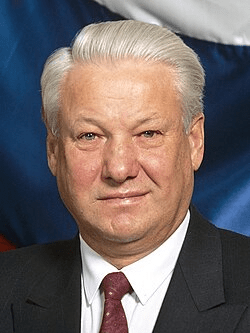
Boris Yeltsin
(1931-2007; 1992 photo)
Like a rudderless ship the whole country lurched on at the mercy of wind and wave. It resembled nothing so much as a drunken wedding party: complete with musicians and Gypsies, it was doing the rounds of all the taverns in the town. At that time, Yeltsin’s entourage lived in a constant succession of feasts and celebrations. It was impossible to get hold of anybody, either at home or at the office. I wore my fingers to the bone, dialling Moscow numbers week after week, until, by chance, I stumbled on the rhythm of this dolce vita. All Moscow, apparently, was attending “launches”, a newly-adapted Western concept that on Russian soil meant almost any kind of drunken get-together, to mark the opening of some new centre or firm, or to celebrate an anniversary. And how could you reach agreement on anything serious between scoffing sturgeon and toasting the new democracy?
In the meantime, events were developing in a manner highly unfavourable to my plans. The old bureaucracy was reviving visibly and filling the vacuum at the top. This was done quite openly, to the accompaniment of assertions in the press that the running of the country should be left to the “professionals”. The tone was rather insistent, implying that the old regime had not allowed the professionals free rein, and now the new authorities were heading in the same direction. Somehow it was overlooked that the Soviet Union was never governed by professionals apart, that is, from the professional “builders of Communism “, i.e. the nomenklatura (the managerial elite of the USSR). It was they who wrecked the country, bankrupted its economy, and finally could not organize an effective coup d’état.
Consequently, the investigation of these comrades, the putschists, fizzled out. Before leaving Moscow at the end of September, I managed to make a program for Russian television promoting the idea of an investigation into “the case against the CPSU”. It was titled “Two Questions to the President”. We suggested following the Watergate model, which had posed two key questions: What did the President (Gorbachov, in our case) know, and When did he know it? These were not idle queries. There were growing indications that Gorbachov knew of everything in advance, and the “putsch” was his attempt to declare a state of emergency while hiding behind the backs of his comrades. In drawing this parallel, our programme suggested the necessity of a Watergate-type public hearing.
Yet this seemingly self-evident idea was swamped by the appalling disorder in Russia. Yeltsin could not bring himself to take a decision while the newly buoyant nomenklatura, including elements of Yeltsin’s entourage, buried everything in innumerable investigative commissions which were led, naturally, by “professionals”. It became clear that the leaders of the August 1991 putsch would probably never face trial. (Indeed, their trial was postponed until February 1994 when the newly-elected Duma passed a law granting the organisers of the August coup an amnesty. One of the accused, General Varennikov, refused the amnesty and demanded a trial. The trial was held in August 1994 and he was acquitted.) In October 1991, there were rather feeble hearings in the Supreme Soviet at which some deputies called for a more comprehensive investigation into the circumstances of the putsch and of all the activities of the CPSU. Naturally, their Communist colleagues objected. A three-ring circus, no less! Since when has it been obligatory to seek a criminal’s consent before putting him in the dock?
Curiously, the prospects of investigation into the criminal activities of the CPSU did not arouse enthusiasm among most the “moderate” public. For some reason, people were particularly concerned about the international dimension. Certain facts had surfaced during the hearings, mainly concerning foreign Communist parties, and they were not very significant: they revealed, for instance, that millions of dollars had been pumped from the State coffers into “Firms run by the Friends” (see Chapter 1, part one, “1.3: “Firms run by Friends”.). That was already enough, however, to cause an outcry. In October 1991 Izvestiya wrote “The inquiry into the CPSU reaches far beyond Russia’s borders”:
It seems likely that the investigation will yield many more documents of this kind and it is impossible today to estimate the consequences of this work. The scandal seems likely to spill over into the international arena, where it will have a serious effect on the careers of many politicians, affecting the activities of foreign Communist parties and many commercial structures, raised on the financial leaven of the CPSU.
Homo sovieticus cannot hear such words as “foreign” and “abroad” without shitting himself, alas, and Yeltsin proved to be no exception.
On 14 January 1992, the Russian President signed a decree “On the protection of State Secrets of the Russian Federation “, reinstating practically all the norms of secrecy of the former USSR. On my return to Moscow in March 1992, I encountered a typically Soviet example of window-dressing. A “Centre of Contemporary Documentation”, which supposedly contained the Party archives and made them available for public scrutiny, was triumphantly opened at the Archives Committee. Thanks to Pikhoya this was celebrated in the domestic and foreign press as the latest milestone on the road to the new democracy. After obtaining a pass, it is true, one could go up to the second floor of the former Central Committee building, enter the reading room and look at the lists of documents. Here the democracy of the new Russian authorities ended abruptly, however. No texts of any interest could be studied. Before you could gaze at the lists, you were instructed in the “rules” of the Centre. In accordance with Yeltsin’s decree, the following were inaccessible:
- All documents after 1981;
- All materials concerning decisions made after 1961 by the Secretariat of the Central Committee;
- All materials classified “Special File”;
- All post-1961 materials concerning the International, Foreign Cadres, International Information, Administrative Bodies, and Defence Industry Departments of the Central Committee, or post-1961 documents of the KGB and GRU.
If you liked, you could acquaint yourself with plenary sessions of the Central Committee discussing agriculture or the fulfilment of the five-year plans. If not, then that was it. I was denied access to those documents which personally concerned me. They recorded my life and fate but were listed in the inventory among the decisions of the Central Committee’s Secretariat. As for some “international commission” – forget it! In vain did I wave our agreement under Pikhoya’s nose, pointing to his signature. He merely flashed his glasses in my direction and reiterated: “That’s no longer valid.”
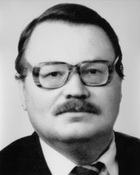
Rudolf Pikhoya
His signature on an agreement, with a delegation of our founding organizations, which I had forwarded to him in October after my own departure from Moscow proved equally “invalid”. Presumably the same applied to all the agreements he signed with other organizations, intending to “sell the same goods” over and over behind our backs. There were about a dozen such agreements. Each partner proudly announced to the press that it had obtained exclusive access to Party secrets. A month or so later, the same claim would be made by yet another equally triumphant body. There is nothing surprising in this, because Pikhoya’s dream was as simple as it was unattainable: to make lots and lots of money without letting a single document out of his hands and, God willing, without bringing his bosses’ wrath down on his head. He dreamt of millions of dollars made in exchange for accounts of the Party’s youth work, sold to crowds of eager buyers, while adopting the air of a benefactor to mankind. As was to be expected, he ended up with nothing and took umbrage at the West.
“Those sons of bitches,” he complained bitterly to me – of all people! – “They all want exclusive rights. Well, now I won’t give anything to anyone!”
Undoubtedly, the 30-year rule (“just like in England”) which he so favoured was enshrined in Yeltsin’s decree not without Pikhoya’s assistance. After all, only that which is “forbidden” has a market value, only that would become his “personal property” to do with as he wished. The permitted materials aroused no interest, because they would have to be issued free of charge.
So, my idea of a “Moscow Tribunal”, a fitting conclusion to the greatest war waged by mankind, died stillborn. Nobody in our immense country, devastated by that war, was moved by a sense of duty – to history, to truth, to the memory of its victims. No one evinced any interest, apart from the carrion crows which appeared from nowhere to tear at the fresh corpse. Bureaucratic nonentities who suddenly found themselves in positions of power boosted their self-importance by disposing of something to which they had no moral right: our heritage. Insignificant nobodies who had worn out the seats of their pants in Party committees denied us, who had borne the brunt of that struggle, the chance to learn the whole truth about our lives. Was I to endure this, too?
Leaving Moscow at the end of March 1992, I gave several scathing interviews, a calculated slap in the face. So that, I said, is the real nature of your “democracy”, which has risen in defence of Communist secrets: “‘No one here needs us,’ says Vladimir Bukovsky” (Vechernyaya Moskva, 7 April 1992).
“Can you imagine a 30-year moratorium being placed on all Nazi documentation after the fall of Germany? The new Germany did not hide the old Germany’s secrets. When you make a serious break with the past, there is no need to conceal that past,” I told Izvestiya. The newspaper did not pluck up the courage to publish this interview for a couple of weeks (“Vladimir Bukovsky: to keep to the right a strong left opposition is needed”, Izvestiya, 3 April 1992). I thought they would never get around to it. “To hell with them,” I told myself. “A slap in the face only works on someone who has retained a sense of honour.”
In all honesty, I had no intention of going to Russia again.
*
2.5 It’s an ill wind …
It’s an ill wind, they say, that blows no one any good. By the spring of 1992 the Communists had become brazen enough to lodge an appeal in Russia’s Constitutional Court against Yeltsin’s decree outlawing the CPSU.
To an impartial observer, it must have seemed like a bad joke. One group of Communists was taking another group of (former) Communists to court, claiming that the ban on the party to which they had both belonged was unconstitutional; the case would be heard before judges who were also former Communists. And this, mark you, in a country without its own Constitution. There was only the old 1977 Constitution, which the law-makers could not agree to replace and, therefore, had amended several hundred times. It was a situation to beggar the imagination of Kafka and reduce Hegel’s dialectics to childish babble.
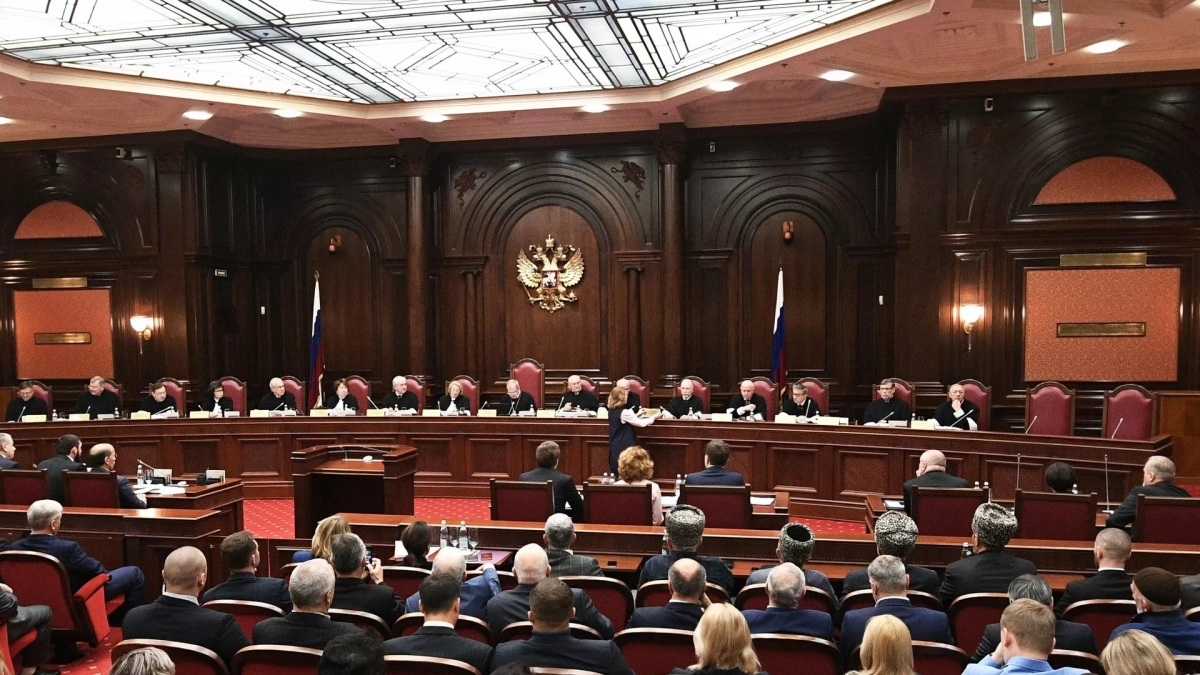
CPSU on trial
For Yeltsin and his entourage, however, it was no joke. The possibility of the Court accepting the appeal was real (at least seven of the twelve judges were openly sympathetic to the CPSU), and the consequences would be appalling. Apart from the political complications, it would mean returning recently appropriated “Party property”, which included the Central Committee complex on the Old Square, newly occupied by the Russian leadership, to say nothing of the Party archives. With good reason Yeltsin cited this court case as one of the most urgent problems facing the country when he addressed the US Congress in the summer of 1992.
Alarm, even panic, seized all the President’s men. As a result, after almost a year of unsuccessful petitioning the Communist Party archives were opened, just a crack, and I gained access to them. I was hurriedly summoned to Moscow to take part in the hearings as an expert witness: access to the archives was my categorical condition, payment, if you like, for appearing in the impending farce. As was to be expected, our aims were rather different. The commission selecting documents from the archives was seeking illustrations only of the “unconstitutional” activities of the former Party leadership, and the materials they chose were quite insufficient for a systematic study. A miscellaneous collection of documents from different periods was grouped somewhat arbitrarily into 48 volumes under very general headings: “Violations of human rights “, “Terrorism”, “Corruption”, and so on.
Moreover, the general feeling of uncertainty and ambiguity in the country was reflected in the composition of the commission and its methods of work. Since neither the President not the government could come up with a coherent definition of the new Russian State’s interests, decisions concerning what was and was not still a State secret were left up to officials who had belonged to the Party. At times, their arguments were positively surreal. It had been decided, I learned by chance, not to lift the seal of secrecy from a list of Western journalists on the KGB payroll (one document did appear, concerning KGB payments to a “legendary” Australian war reporter, 25 October 1957*, St 52/128). I wanted to know why. “Well, really, how could we?!” was the response. “They’re still alive…”
What struck me most about these people, however, were their staggering ignorance and provincial mentality. They were the new political elite, the brains trust of Yeltsin’s team, his closest and most trusted advisors, and yet they simply knew nothing about the outside world. I chanced to see the minutes of one of their meetings, where it was decided not to declassify a document concerning the KGB’s financial assistance to Rajiv Gandhi. The members of the commission, it later emerged, did not know that Rajiv Gandhi was dead; they feared that if the details were to become public, it could provoke unrest in India! In any case, strictly speaking, this commission saw only what it was shown, or to be more precise, matters which could no longer be concealed.
xxx
In the shifting world of the Communist twilight, nothing was really what it seemed. For instance, the staff at the archive, without whom no commission could find a thing, were often former technical personnel at the Central Committee who had obtained their jobs, in most cases, through high Party connections and, sometimes, through relatives. It was hard for such people to overcome the instinctive habits of years working in the most secret repository of the world’s most secretive State.
Searches for documents encountered silent but stubborn resistance – almost sabotage, in some cases – from archive staff unwilling to issue any of the materials entrusted to them. Such reluctance is also to be met in the archives of normal countries. In the Central Committee archive the reluctance of some was reinforced by fear; some wanted to extract the maximum benefit for themselves; some were motivated by political sympathies; and some were petty bureaucrats trying as always to boost their importance and humiliate any who sought their services. Taken together these attitudes constituted an almost insuperable barrier. The members of staff who behaved like normal people and were willing to help researchers could be counted on the fingers of one hand.
It is not difficult to imagine what the commission’s members had to go through to scrape together those 48 volumes. They started work in April 1992, immediately after the case was taken up by the Constitutional Court. Yet when I arrived at the end of June, things had barely begun to move. Documents dribbled in all summer and autumn, some of them were “found” toward the end of the trial, and only because of Yeltsin’s personal intervention. Some remained “not found”. I could appreciate the difficulty of extracting any information when, dissatisfied with the “finds” of the commission, I began to demand supplementary documentation. Nobody refused me directly, but documents and the identity of those withholding them proved elusive. What can one say to a bland assertion that this or that document cannot be found? Locating items in the Central Committee archives was no simple matter, it was true, as the holdings consisted of several billion documents.
The matter was further complicated by the recent division of the archive. In 1990 its most important part, the archive of the Politburo, with all its decisions and minutes of meetings since 1919, had been transferred to the Kremlin, where it was amalgamated with Gorbachov’s Presidential archive. It was physically impossible to gain access without special permission from Yeltsin, who inherited that archive, together with the Kremlin, at the end of 1991. In the main Central Committee archive it was possible, at least, to check the inventory lists (i.e. the catalogue or register giving the date, reference number and title of a Central Committee decision) before trying to secure a document. The Politburo archive was totally inaccessible. Obviously, one cannot ask to see a document if one does not know of its existence. The staff of the Presidential archive were openly mocking in their brief and insolent replies to my detailed requests. “No document found. Can you give us the date and reference number?” they asked, knowing full well that I could not possibly do so.
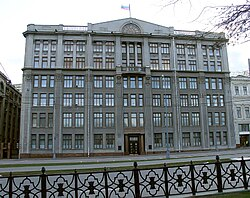
CPSU Central Committee building
The Central Committee archive was not much better. Its inventory gave the most approximate idea of any document’s contents, in most cases providing only an official title: “Request from the International Department” or “KGB Memo, such and such a date”. You had to guess whether you needed this document or not. Was it worth weeks and months of determined effort? Often, after jumping through innumerable hoops, the document proved useless.
All my experience as a prisoner, struggling against such a bureaucratic system, proved invaluable. Every time, I would go to the “top” and organize pressure from above on the lower ranks, inventing countless reasons why I needed this or that document for my appearance at the coming trial. There was hardly a trick I didn’t try. From our arsenal of prison stratagems, the only one I never consciously employed was bribery. Perhaps I was wrong, but it seemed too demeaning to descend to this level, as offensive, say, as a former inmate of a Nazi concentration camp trying to buy documents from the SS to indict the Nazis. The thought that the scum whose well-being was built on our bones would now derive profit from their former activities was too repugnant to contemplate. There were times, I regret to say, when I became so infuriated by their sabotage that I imagined how, had I the power, I would take them out into the yard in small groups, put them up against the wall, and shoot them. Then go back inside and ask in a quiet, steady voice: “Now, how about that document? Has it turned up yet? No?” and lead the next group out to the yard.
Whether I had simply forgotten the servility of Soviet people, their dishonesty and willingness to bow only to force, or whether their final demoralization occurred during the fifteen years since I had left the country, I do not know. Whatever the reason, I could not deal with them without a constant feeling of revulsion. They seemed a sort of hybrid, Gogolesque heroes with the mentality of Dostoevsky’s characters, and all aggravated by 75 years of Soviet existence. I was amazed by the recklessness of Western businessmen who scurried to enter “eastern markets” at a time when I was finding it hard to discern the motives of my former fellow countrymen. During a casual and superficial encounter these motives proved innumerable and, more often than not, quite irrational. Take, for example, the nondescript, nervously sweating man who came up to me in a corridor in the archive complex, motioned me into his office and surreptitiously showed me a bundle of documents. What did he want? I wondered. Why is he doing this?
“Can I copy these?”
“Heavens, no, under no circumstances…” Hands raised in horror, desperation in his eyes.
“Can I read them?”
“Give them a glance…maybe you’ll need something…”
The documents were nothing special; I had seen much more interesting texts. These I could do without. They did not tell me anything new, but it seemed awkward to just stand up and leave – what did he want? I felt sorry for him, too. He had made an effort and now he was in a lather – was it his own daring, nervousness, or the stuffiness in the room?
“And if I do need them?”
Silence. Then he muttered something incoherent.
Somehow, I felt grubby, and any moment I’d probably start sweating as well. Did he want money? Praise? Love? I don’t know. I was almost prepared to abandon my usual practice and give him some money, just to put an end to the situation. But what if he took offense? What if he was acting from the heart, and not motivated by mercenary considerations?
“So, I can’t copy them?”
“No, no, that’s impossible…”
A long, painful pause.
“You need some help?” Sure enough, I’d offended him. He pursed his lips and began sweating more profusely. Devil take it, what was I supposed to do? What was I misunderstanding in his mysterious Slavic soul? Maybe he genuinely wanted to help me, and this was the only way he could imagine? Perhaps, having lived all his life in unswerving obedience to the regime, he had suddenly rebelled and accomplished an enormous feat of courage by showing me those papers. Only the courage was insufficient to let me copy them.
Those who actively hated me, or who secretly sympathized with my aims, were both in a minority. Most of the staff, that ever present “silent majority”, was completely indifferent to my work in the archive. The curious fact of my presence in the former building of the Central Committee, where the walls were still decorated with portraits of Marx and Lenin and the doors still bore such nameplates as “Deputy section head, Perepelkin G.V.”, did not affect them in any way. In similar fashion, they perceived all the changes taking place in the country as nothing more than the regular replacement of one set of bosses by another. Quite soon I realized that their attitudes towards me – varying one day from a sycophantic willingness to please, to polite indifference the next, and cold formality on the day after that – did not signify anything personal but accurately reflected the way the wind was blowing in the upper echelons of power. In time, I became so well attuned that I could gauge the political climate in the country at any given moment, and reach an unerring conclusion as to which side, in the permanent Russian struggle for power, then had the upper hand. Having learnt of the latest changes at the top, moreover, I could accurately predict whether I would be given a document I requested.
Sadly, it seemed, the “silent majority” throughout the country had likewise become accustomed over the years to being no more than the corps de ballet. How could such people possibly be transformed by “democratic innovations” or “market relations”? In this kingdom of functionaries, where a bureaucrat became a poet and a poet became a bureaucrat, the interpretation of democratic ideas was most idiosyncratic: they were taken to mean the right of a functionary to disobey his direct superior by proclaiming the “sovereignty” of his region, city, or enterprise. No common interest emerged to replace blind obedience, however. The idea of “the common good” had been abused too long and too brazenly by the Communists. Lacking such vertical integration, country and society were falling apart. Yet every separate fragment retained its Soviet mentality, with all its servile system of relationships.
Things stood no better with those who came to believe in the “market”. It would be hard to think of human material more unsuited to honest business. First and foremost, Soviet man believed that any “business” was founded on the cheating of one side by the other. Otherwise, how could one make a profit? At whose expense? Before the revolution such attitudes had been considered reprehensible or criminal; now, at the whim of Russian history, they became the norm. This was perceived as the “capitalism” so long proscribed by the Communists because they wanted to keep its benefits for themselves. As with the real caviar and the good-quality salami, they didn’t want to share it with the people.
This is no joke; it was a sad reality. It was simply impossible to explain to a Soviet person that business functions properly only when everybody benefits. Talk of honesty, that a businessman’s reputation is his most important asset, elicited the same sardonic grimace as Soviet propaganda in earlier times: yes, all this must be said for form’s sake, it’s the ideology, but in reality…
Born in falsehood, raised on deceit, Soviet people were firmly convinced that the world was like a “matryoshka”, a Russian doll: the outside was decoration, it was “for fools”; whereas the doll inside was a completely different matter, it was the real thing. More than anything else in the world, homo sovieticus feared to look a fool: this made reaching an agreement with him, let alone doing business together, a mind-boggling proposition. First, he had to determine what was “really” behind your offer; he had to know who stood behind you, and who was standing behind them, down to the last “matryoshka”. Before you had said a word, he was firmly convinced you intended to cheat him, just as his task was to cheat you. What kind of basis was that for business? At best, like Gogol’s Korobochka, he would go off to find out “the going price for dead souls” and would do his utmost to sell the same consignment of goods to several people at once. At worst, he would try “selling” an item he did not possess, or “buying” something without paying a kopeck. The latter was his idea of business virtuosity, an achievement of which only the smartest could boast: if the aim of business was to buy cheap and sell dear, then the ideal must be theft, pure and simple. Left with nothing at the end, homo sovieticus took umbrage against the whole world.
If this description did not fit most people in Russia, it applied to a great many. Their superiors, all those Pikhoya s with their naive get-rich-quick schemes, were no better. What did Pikhoya gain from all his intrigues, and worthless “agreements” with Western institutions? All that effort to end up like the proverbial dog in the manger. Faced by the Constitutional Court hearing, the “Big Boss” forgot about his decree and the vaunted 30-year rule. Yeltsin demanded that the warehouse be thrown open, forcing Pikhoya, the very image of a dispossessed peasant on a collective farm, to give up “his” property. For, despite all his ambitions, he was (and remained) only the warehouse manager, looking after goods that belonged to someone else.
He was a pathetic sight. I thought he would have a seizure at any moment. In fact, he did take to his bed with a heart attack – or perhaps, in a last desperate effort to weasel his way out of the situation, he simulated one. Who can say? His pitiless superiors dragged him out of bed: open up the archive and search! When did the Russian leadership care about anyone’s heart attacks? And Pikhoya, clutching his chest and swallowing pills, searched. Acting through his bosses – a deal is a deal, if you want my help, you open the archives – I extracted document after document from him. Only four months earlier he had refused to show me something which concerned me personally: the Central Committee decisions which led to my being thrown into prison and, later, expelled from the country. Now, timidly and almost without protest, he opened “Special Files”, KGB reports, and International Department documents, the Central Committee’s Holy of Holies.
“Well now, Rudolf Germanovich,” I could not resist saying when the two of us once found ourselves alone together in the recreation room at the Constitutional Court: “you used to tell me no one would ever see this or that. Was it really worth resisting so much, only to surrender everything now?”
“Never you mind,” he muttered glumly, “this madness with the Court will end sooner or later, and then everything will be back to normal.”
He was right. The hearings ended, and by spring 1993 my good fortune ceased as unexpectedly as it had begun. The archives were shut tight, the 30-year moratorium was restored, and what I had managed to salvage during the frenzied period of the trial, even the volumes of documents amassed by the commission, were once again classified as secret. Perhaps for ever.
xxx
I understood this quite as well as Pikhoya, however. Foreseeing that I would not be allowed to make any copies – because no photocopier was available, supposedly, or special permission was needed for every scrap of paper, or for God knows what other reason – I took the precaution of acquiring a portable computer with a hand-held scanner. This piece of high tech, a miracle of Japanese manufacture, had only just appeared in the West and was completely unknown to our naïve Russians. I could sit and scan piles of documents, page after page, right under their noses, with no worries about curious onlookers, who kept coming up to admire my machine.

Hand-held scanner
“Look at that!” exclaimed the leaders of democratic Russia, peering admiringly over my shoulder. “That must have cost a few bucks!”
Nobody realized what I was doing until December 1992, when the Court hearing was almost over. Then, suddenly, one of them was struck by a horrible thought and yelled loudly enough to be heard all over the building:
“He’s been copying everything!!!”
There was a deathly hush. I kept scanning, as though I had not heard.
“He’ll publish everything OVER THERE!!!”
I finished work, packed up my computer and headed calmly for the door, looking neither left nor right. From the corner of my eye, I could see the horrified faces of Yeltsin’s elite, frozen in disbelief, and Pikhoya’s childishly hurt features which seemed to say: “Let him! Serves you all right!”
Nobody said a word as I made my way to the door. They were probably busy calculating what untold millions I would make in the West.
… And that is how the pile of classified documents marked “Secret”, “Top Secret”, “Of Particular Importance” and “Special File” came into my hands. Several thousand priceless pages of our history.
*
2.6 All rise, the court is in session!
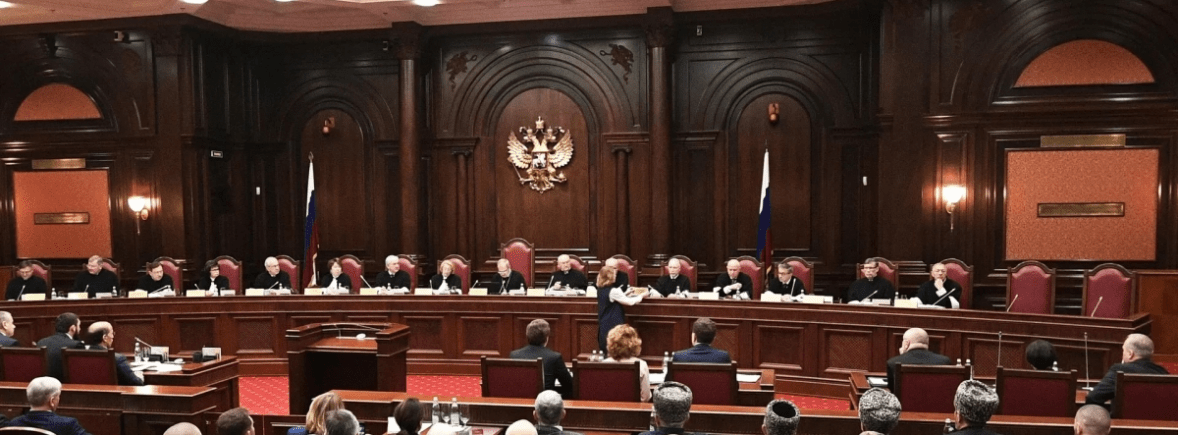
The Constitutional Court hearings of “the case against the CPSU” opened with a great deal of pomp on 7 July 1992. The judges in their specially sewn black gowns were all former members of the Party.
The “plaintiffs” were former secretaries of the Central Committee and Politburo members, the “defendants” were the presidential team, vice premiers, and ministers, who were also former Party functionaries, but junior in rank to their “opponents”. The experts had all been professors at Party institutes. To complete the picture, I should add that this show was staged in the building of the now defunct Party Oversight Committee of the CPSU Central Committee. It was highly reminiscent of an internal Party investigation into non-payment of membership dues.
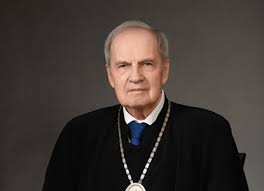
Valery Zorkin
Presiding over the court was Valery Zorkin (he left the post in 1993 but returned in 2003); he was togged out in a black gown but with a gold chain of office around his neck. He was intently studying a small brass gong on the table before him, obviously trying to gauge how hard he could hit it without sending it flying.
“Is he, at least, an honest and decent person?” I disconsolately enquired of my neighbour, a representative of the “presidential side”.
“Oh, yes,” he answered cheerfully. “He’s one of ours. Marvellous man. Used to be a professor at the Academy of the Ministry of Internal Affairs.”
I bit my tongue. It served me right for asking silly questions. My understanding of “ours and theirs”, “decent and not decent” was clearly quite different.
*
Of course, this court case really concerned the rival claims of two factions of the CPSU to the property of the Party. It was a pale travesty of the “Moscow Tribunal” I had envisaged, and my participation must have appeared incongruous.
The idea of entrusting the Constitutional Court, instead of a criminal court, to examine the case was a fundamental compromise, which effectively tied the hands of those who took part. Everyone, including the President of Russia, realised that it was essential to proscribe the CPSU because it was a criminal organization – not because its activities had, allegedly, breached a Constitution it had itself created. To give a strict legal ruling on this accusation would be as impossible as deciding which came first, the chicken or the egg. Several hundred amendments had been introduced to this Constitution, moreover, for the very reason that it had been drawn up for the convenience of the Communists. It would be legitimate to ask, therefore, in breach of which Constitution had the CPSU acted? The original 1977 Constitution, or the current, amended version, which rendered their activity unconstitutional? It was nonsense.
As was to be expected, the press and the public quickly saw through this crafty move. The Russian people may be passive, careless, and God knows what else besides, but they have never been stupid. The newspapers had a field day wondering, with seeming incomprehension, why the court was not applying international law, which was quite sufficient (on 30 June the government paper Rossiyskaya gazeta took up the theme). On 15 June 1992 Moscow’s evening newspaper Vechernyaya Moskva published an article by legal specialist A. Melechnikov entitled “No Statute of Limitations”:
“There is the London Agreement of 8 August 1945 concerning the prosecution and punishment of the main military criminals of the Axis countries; the judgment of the International Nuremberg military tribunal of 1 October 1946; the 11 December 1946 resolution of the General Assembly of the UN adopting the principles contained in the Charter and the judgment of the Nuremberg tribunal as acting norms of international law. There is the international pact on ‘The unacceptability of a statute of limitations on war crimes and crimes against humanity’.
“The norms contained in the above-mentioned sources were first applied to German National Socialism. Yet it would be wrong to assume that the situation which has arisen on the territory of the former USSR differs in principle from that, which was assessed in the judgment of the International tribunal of 1946. It has emerged that both Germany and the USSR cooperated in the attack on Poland in 1939. Then, in accordance with secret agreements with Germany’s political leaders, Soviet communal socialism attacked Finland, annexed Lithuania, Latvia and Estonia and part of the territory of Rumania. As for the killing of thousands of Polish prisoners, seized in the aggression against Poland – was this not a uniquely cynical and inhuman war crime?
“The criminal organization which exercised power in the USSR drew no conclusions from the Nuremberg trials, at which, by force of historical circumstance, the dock was occupied solely by the National Socialist Workers’ Party of Germany.
“Let us remember: 1950, participation in the outbreak of civil war on the Korean peninsula… 1956, armed intervention in the internal affairs of Hungary… 1968, an identical intervention in the internal affairs of Czechoslovakia. And 1979, the invasion of Afghanistan.”
Nothing could be simpler, it would seem, more convincing or more logical. But no, the former Communists failed to summon sufficient resolve and could not take such a step. Neither Yeltsin nor his entourage wanted to be identified as accomplices in crimes against humanity. Instead, they had to think up an awkward and convoluted caveat, proving that the CPSU had “substituted itself for the State” and was thereby unconstitutional. But not criminal – God forbid! The Court forbade the use of this term. This was the Constitutional Court, after all, and it was not empowered to deal with crimes. The representatives of the CPSU were quick to exploit this weakness. On the opening day of the hearings, Pravda devoted its entire front page to the case. Under a huge headline: “Gentlemen! When were you telling the truth? Yesterday or today?” it published quotations from members of the President’s team when they were Party officials next to their more recent pronouncements.
The same could be said of most of the witnesses for the presidential side. They were all former Party members, if not leading Party figures. So, the defenders of the CPSU chose what they thought was a very cunning strategy, putting the same question to every witness: “Do you consider that all Party members are responsible for the Party’s activities?” What could these former Party members reply? Nobody wanted to assume equal responsibility with their former Party.
“Aha!” crowed those representing the CPSU. “The Party is the 18 million members who comprised it, not a mere handful of leaders.”
Then, triumphantly, they produced their witnesses, provincial Party members who, under oath (and quite sincerely), assured the Court that they had never taken part in any unconstitutional activities. It is hardly likely that CPSU members in the Vologda Region were engaged in international terrorism; they did not invade neighbouring countries or persecute dissidents. They were preoccupied with bringing in the harvest and fulfilling five-year plans.
Moreover, the CPSU representatives (experts in dialectics, to a man) insisted that the Party had changed completely after some congress or plenum or resolution when it denounced past actions, and so could not be brought to book. Tens of millions were killed under Stalin, nobody was denying that, but, after all, this was roundly condemned in February 1956 by the 20th Congress of the CPSU. Khrushchev and Brezhnev committed their share of offences but they were later denounced, were they not? The last time “undesirable practices” were denounced was in 1991. This allegedly signalled a total rebirth of the Party, and now they could have lived and flourished as never before. Alas, for no reason whatsoever, they were banned…
Unfortunately, the “presidential side” could not come up with a convincing rebuttal of such specious reasoning. Raised also on dialectical materialism, they considered that they bore no responsibility for the past after they left the Party and condemned it a year or two earlier. Furthermore, they believed they had a perfect right to sit in judgment on their former colleagues, who had been less quick on their feet. It was patently obvious why they were so eager to have me, and two or three other dissidents, appear as witnesses: we were not bound by Party dialectics, and, in our responses to questions, could say what none of them could utter.
Our very presence endowed the proceedings with meaning. This was certainly felt, if not understood, by all present, and that is why the judges and the CPSU members were unfailingly respectful in their dealings with us. This clearly annoyed some of the people in the presidential team, though they were probably unaware of the true reason for their discomfiture. One of them informed me, quite out of the blue, that he had demonstratively quit the Party on 19 August, the first day of the putsch: presumably, I was supposed to be amazed by such daring. Another told me, at tedious length, how cruelly and unjustly he had suffered for his freedom of thought: instead of being promoted to the post of a Central Committee Secretary, he was “exiled” as an ambassador to a Western country. These were not the birth pangs of conscience but something like the yearning in the eyes of a monkey as he surveys his tail-less upright relative.
Both the participants and spectators treated this farce with great seriousness. There was no shade of irony, not a hint they understood the absurdity of the situation. A police cordon restrained the crowds that gathered every morning outside the building, one side clutching red flags, the other holding white, blue and red banners. The courtroom was packed with the press and interested onlookers. CPSU supporters sat to the right of the aisle, the President’s supporters to the left, and God forbid if you sat on the wrong side!
Former Central Committee Secretaries and Politburo members who, until recently, held the fate of the world in their hands and those who now sat in judgment on them crowded that stuffy room for hours, trying not to miss a word. What were they expecting to hear, what truths did they hope to discover? Summoned as witnesses, they got tangled up in stupid and petty denials. They lost their tempers and cursed, just like inexperienced thieves caught with their hands in the till. The once all-powerful Ligachov spent the long weeks of the trial sitting on the edge of his chair, straining forward with a hand to his ear, a pose someone much younger would have found difficult to sustain. What could this old buffoon possibly NOT know about his Party? Former Politburo member Dzasokhov, like a guilty schoolboy, denied his own signature under some document. Surely, he could have thought up something more convincing. Summoned from Germany, Falin wriggled around like a handful of worms. These were powerful figures; I had seen their signatures on frightening documents and resolutions which had cost many people their lives. I had imagined them to be perfidious, omnipotent fiends, but viewed at close quarters they turned out to be fools. Poorly educated, inarticulate fools, capable only of the stereotyped thinking of Pravda editorials.
Those on the “presidential side” were not much better. They were a touch more intelligent and better educated, but only on the surface. Looking at this line-up of the Soviet “elite”, I recalled an old joke which did the rounds in the 1960s. There are three qualities which cannot coexist biologically in one person: intellect, honesty, and Party membership. One of the three was invariably excluded. If a person joined the Party he would either be a smart scoundrel, or an honest but dim-witted fellow. When the crisis of the regime came, that is exactly where the split ran: a minority of clinical idiots continued to march and wave red banners, while the cynical majority quickly metamorphosed into “reformers”, “democrats”, “nationalists” and “free marketeers”.
As far as they were concerned, the events in Russia did not constitute a revolution or liberation from totalitarianism and certainly led to no sacrifice of their ideals. It was simply an opportunity to advance their careers, jumping a couple of the old hierarchical steps in one go. How could Leonid Kravchuk, Central Committee secretary for propaganda in the Ukrainian satrapy, pass up the chance of becoming President of a sovereign, nuclear state? How could Yegor Gaidar, economics editor of Pravda, turn down the post of Russian Prime Minister? Who cared whether it was now called democracy or socialism. For people like these, devoted to their own privileges, “democracy” merely meant new opportunities for deceit, while the “market economy” signified one thing and one thing only, corruption. For that reason, they stifled any independent initiative under the guise of stamping out corruption, justifying their own corruption by invoking “market forces”. Having seized power with a Lenin-like grasp, they would never allow anything new to develop, except for a new mafia in place of the old.
No more than a month after the August putsch, the new “democratic” rulers moved into the Kremlin, took over the buildings of the Central Committee, and appropriated the cars, dachas and apartments of the old regime, registering in its clinics and gaining access to its special supply of goods and foodstuffs. They stole on a scale unimaginable in Brezhnev’s time. There was no way they would hand this over to the less agile, more stupid leaders of their former Party.
xxx
This was what lay behind the proceedings in the Constitutional Court; this was its hidden meaning. I spent half an hour in the courtroom on the first day, and did not return until I was called to testify. Instead, I sat in the recreation room, where, if necessary, one could watch the proceedings on a monitor, and I scanned documents. Or I went across the road to the Central Committee archive. When I got tired of sitting over my computer, I would go out and stroll along streets I knew from childhood, but there was little left from those days. It was like being in a completely unknown city.
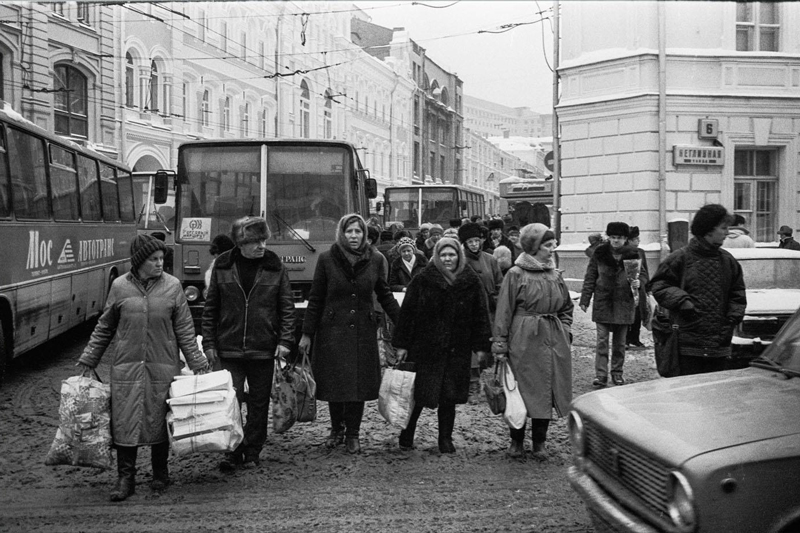
Moscow in 1990s
Moscow resembled a monstrous ruin, as though it had been subjected to intensive bombardment by American warplanes. Whole streets had disappeared, replaced by ditches: were these anti-tank defences, or were they laying new sewage pipes? Who could say. Row upon row of empty buildings with sagging facades and blind windows, huddled on each side. Grass and small bushes sprouted through mounds of fallen plaster. This desolation was obviously not new. It had happened over many years, probably since the time when, due to some mysterious cataclysm, life here came to a standstill. I could not find the house in which I had lived: it had been demolished with all the other houses on our block, and a huge apartment building for the military, in the “late evil-empire” style, now occupied the vacant lot. Only rare glimpses, a miraculously intact moulded cornice on some half-ruined townhouse, the rusty railings on an old wall, stirred memories of a different city. For when I reached fifteen, I realized just where I had been born. From then on, I lived in hostile surroundings, like the advance party of the World Liberation Army, operating behind enemy lines. In my prison cell, I had dreamed of these streets; these alleys and open courtyards had helped me to escape from the KGB on countless occasions. These old houses were the only friends I could trust completely.
Or had it just been a dream? The town-houses and courtyards were no longer there to confirm my memories. The Army did not come to rescue its soldiers: it turned out, much later, that there was no such Army. My life proved a host of phantoms. All that remained was a vast abandoned cemetery and there, as everyone knows, the only victors are the worms. I felt bewildered and bitter and, again, a sense of helplessness and of a life lived in vain.
Damnation. Could we not have brought this chapter of our history to a more honourable conclusion? What did we fail to do? Where did we go wrong? Had our efforts been without hope or meaning from the beginning?
Chapter 3: “Too Few”? (part one) …
(Original translation by Alyona Kojevnikov; edited by John Crowfoot)
*
SOURCES
Chapter Two: Night of the Looters
An asterisk (*) and bold type indicate that the two files from the Bukovsky Archives listed here — one about Memorial, the other about Wilfred Burchett — have been translated into English. The other 20 notes or sources refer to publications at the time or to subsequently added annotations.
(See the book version of the NIGHT OF THE LOOTERS with its 22 notes.)
JC, May 2026
============================================

