PART ONE
- 1.1 Who cares?
- 1.2 Hard currency
- 1.3 “Firms Run by the Friends”
- 1.4 Intellectual Shenanigans
- 1.5 “Special Aid”
- 1.6 Sympathisers and Fellow-Travellers
- 1.7 So, who won?
SOURCES
*
Judgement in Moscow (online)
*
Before me on my desk lay several thousand pages, a pile of documents variously classified “Top Secret”, “Special File”, “Of Particular Importance” and “Personal (For Your Eyes Only)”. They all looked much the same, at first glance.
The slogan “Workers of the World, Unite!” in the top right hand corner of the page seemed almost a taunt. To the left was a severe warning: “To be returned within 24 hours to the CPSU Central Committee (General Department, 1st Section)”. Sometimes the conditions were more generous. The document could be retained for three, seven or 15 days, less frequently for two months. Large letters stretching across the page spelled the words: COMMUNIST PARTY OF THE SOVIET UNION, CENTRAL COMMITTEE.
There were reference numbers and codes, the date, and a list of those who took the decision, scrawling their names on the document as it circulated. Last came the surnames of the individuals charged with implementing the decision. The latter were not entitled to see the document in its entirety: they received an “Excerpt from the Minutes”, the contents of which they could not publicize in spoken or written form. A reminder ran in fine print down the left margin (see 5 October 1979*, St 179/32, p. 2):
“Rules concerning Excerpts from the Minutes of the Secretariat of the CPSU Central Committee
“Photocopying or making notes from minutes of the Secretariat of the CPSU Central Committee, also making any reference to them in oral or written form, in the open press or other publicly accessible documents are categorically forbidden. Retyping the resolutions of the CENTRAL COMMITTEE Secretariat is also proscribed, as is any reference to them in official orders, instructions, directives and any official publications whatsoever.
“Access to secret and top secret directives (excerpts from minutes) of the Secretariat of the CPSU Central Committee, sent to Party committees, ministries, departments or other organizations, is granted only to persons directly involved with the implementation of that directive.
“Comrades who have read excerpts from the minutes of the Secretariat of the Central Committee may not publicize their content.
“(Affirmed by CPSU Central Committee resolution, 17 June 1976, St 12/4)“
The rules governing the use of Politburo documents were stricter still. There the marginal reminder was as follows (see 28 January 1980*, Pb 181/34, p. 1):
“ATTENTION
“A comrade in receipt of top secret documents of the CPSU Central Committee may not pass them into other hands or acquaint anyone with their content without special permission from the Central Committee.
“Photocopying or making extracts from the documents in question is categorically forbidden.
“The comrade to whom the document is addressed must sign and date it after he has studied the content.”
This was how the CPSU ruled: secretly, leaving no traces and often no witnesses, as confident as the Third Reich that it would endure for centuries to come. Their aims were not dissimilar. Unlike the Third Reich, moreover, the Soviet Communist Party had almost achieved its goals when something happened, unforeseen by Marx, Lenin, and the overwhelming majority of people on earth.
*
1.1 Who cares?
The documents spread across my desk were not addressed to me. I had no part – at least, no direct part – in implementing the decisions they contained, and I had no intention of returning them to the Central Committee’s General Department (1st Section).
Shamelessly usurping the privileges of others, I gazed at the signatures of Brezhnev, Chernenko, Andropov, Gorbachov, Ustinov, Gromyko and Ponomaryov (see Biographies), and read their handwritten comments in the margins. Their decisions concerned everything, from the arrest and expulsion of “undesirables” to the financing of international terrorism, from disinformation campaigns to preparations for aggression against neighbouring countries. In these pages the tragedies of our bloodstained twentieth century (to be precise, its last thirty years) had their ends and their beginnings.
It cost me a great deal of effort, over twelve months, to lay my hands on these documents. Had I not succeeded it would have been years before anyone saw them again (if they ever did). Yet the curse of the 7 June 1976 “Resolution of the Central Committee Secretariat” continued to exert a mystical power. No one dared to make these secrets public. Some three or four years before each one of these documents might have fetched thousands of dollars. Now, in the early 1990s, I offered them free of charge to the world’s most influential newspapers and magazines, but nobody wanted to print them. “Why bother?” Editors wearily shrugged their shoulders: “Who cares?”
As in the Soviet joke, where an unfortunate individual keeps hearing one thing and seeing another, I felt the need of a doctor who could treat both ears and eyes. I began to doubt what I saw, heard and remembered. In nightmares, I was pursued by determined young men with regular features, demanding the immediate return of these documents to the General Department (1st Section). It was indeed more than three days, and more than two months, since the documents came into my hands. Yet I had still not found a use for them. How can one tell a bad dream from reality? Only a few years earlier, everything set out in these papers had been hotly denied: at best it was anti-Communist paranoia, at worst it was libel. Any one of us who then dared refer to “the hand of Moscow” was immediately hounded by the press, accused of “McCarthyism” and treated as a pariah. Even those disposed to believe us would raise deprecating hands: “This is all guesswork, assumptions,” they said, “there is no proof.” Well, here it was, with signatures, dates, and reference numbers. It was now available for analysis, study and discussion – take it, check it, print it! “Why bother?” They replied, “Who cares?”
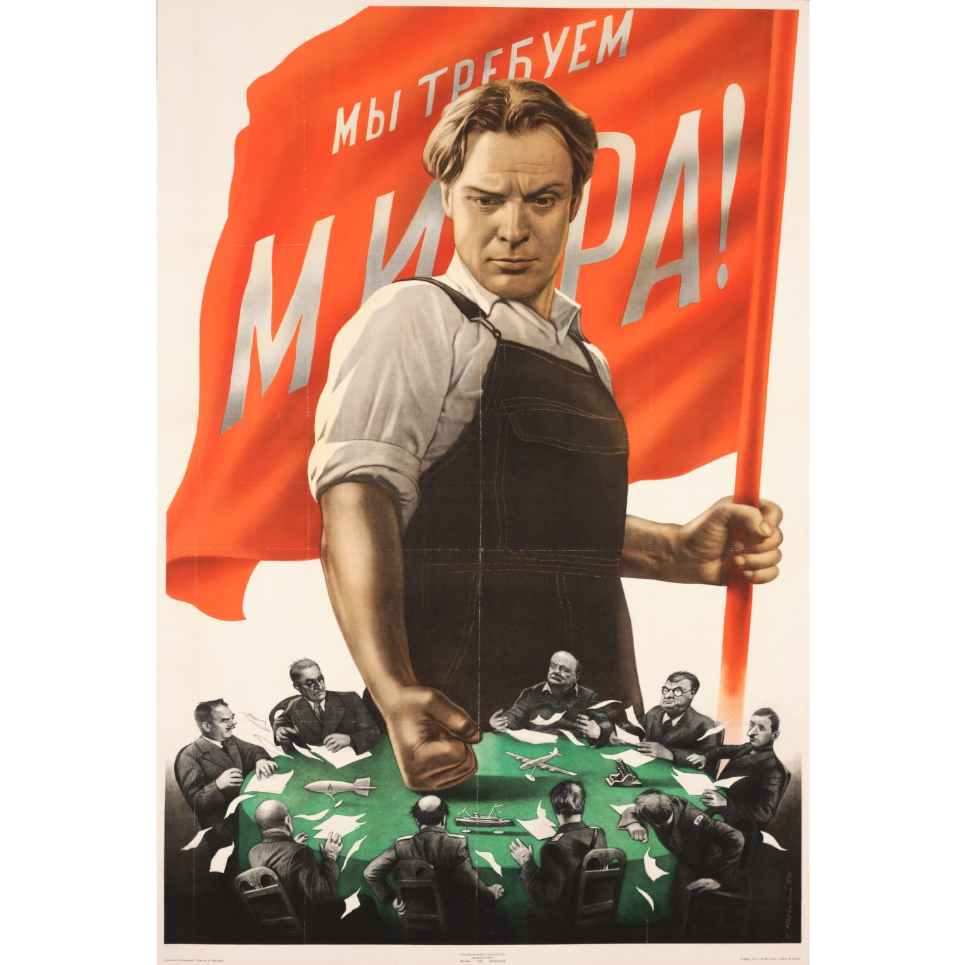
“We demand peace!” (1950)
Naturally, elaborate theories were devised to explain this puzzling response. “People are tired of the tensions of the Cold War,” I was told. “They don’t want to hear any more about it. They simply want to get on with their lives, to work, to relax, and to forget the whole nightmarish experience.” Others commented: “Too many Communist secrets have appeared on the market at the same time.” “We must wait until all this becomes history,” suggested yet another school of thought: “for the time being, it’s still a political matter.” Somehow none of these explanations convinced me. By 1945, presumably, people were just as tired of the Second World War and Nazism, but that did nothing to halt a cascade of articles, books and films. An entire industry of anti-fascist works came into being, and this was not surprising: the need to make sense of something that has just happened is far more acute than any desire to understand the history of an earlier period. People then needed to grasp the meaning of events in which they had played a part; they needed to know whether their sacrifices and efforts had been justified; and they wanted to draw conclusions that would instruct and educate future generations. It was an attempt to avoid the repetition of previous errors and a form of collective therapy, healing the wounds of the past.
Undoubtedly, it is always painful to uncover the truth about recent events. Often it leads to open disputes, since certain participants of yesterday’s drama are still alive and, in some cases, continue to play a prominent role in their own countries. Yet when did such considerations ever restrain the press? A political scandal may be fatal for a certain individual, but it is the daily fare of the media, like a mongoose catching snakes. Why then had our mongoose suddenly grown so timid?
*
In front of me lay a document concerning someone I had never met, a person of whom I knew nothing until then. Yet he was well-known in his own country, it seemed, and in international political circles. Furthermore, he could have become President of Finland.
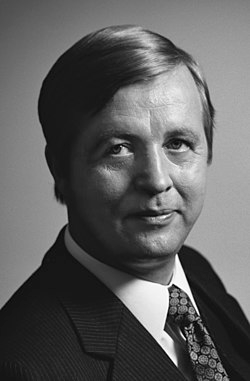
Kalevi Sorsa
(1930-2004)
The title of the document was prosaic (“Measures relating to the 50th birthday of Kalevi Sorsa, chairman of the Social Democratic Party of Finland”) and the text of the Resolution adopted by the Central Committee Secretariat (16 December 1980*, St 241/108) was not particularly interesting. It instructed the Soviet ambassador in Helsinki to pay Mr Sorsa a visit, congratulate him on his 50th birthday, and present him with a commemorative gift. The seeming innocence of this document possibly explains why I obtained it, without any fuss or bother, from the Central Committee archive. Why then was it marked “Top Secret”? My curiosity was aroused. Why should a decision to convey birthday greetings to a former prime minister of Finland, to the leader of the largest political party in a neighbouring neutral country, be shrouded in such secrecy?
I started digging deeper. Such decisions were based on reports and recommendations. Nothing was ever done on the spur of the moment. After lengthy efforts, and ruses which I shall not describe here, I finally found what I was looking for, a memorandum five days earlier (p. 3 in Dec 1980 document) from the International Department. I shall reproduce it in full:
“To the CPSU Central Committee
“On measures relating to the 50th birthday of K. Sorsa, chairman of the Social Democratic Party of Finland
“On 21 December 1980 K. Sorsa, chairman of the Social Democratic Party of Finland (SDPF), celebrates his 50th birthday.
“In his party and governmental activities (as Prime Minister, Minister of Foreign Affairs and chairman of the parliamentary committee on foreign affairs) Sorsa has consistently maintained positions friendly to the USSR and the CPSU. He has promoted the development of Soviet-Finnish relations and fostered stable contacts between the SDPF and our Party. On the international scene, first and foremost in the Socialist International, Sorsa, in confidential cooperation with us, has been working for detente, for the limitation of the arms race and for disarmament.
“In view of the above, and in consideration of Sorsa’s election at its last congress as one of the vice-chairmen of the Socialist International, where he will continue to coordinate the activities of this organization on issues of detente and disarmament, and bearing in mind his contacts with other political forces, we believe it expedient to instruct the Soviet ambassador in Finland to personally congratulate Sorsa on his 50th birthday, on behalf of the CPSU Central Committee, and to present him with a commemorative gift.
“Draft CPSU Central Committee resolution appended.
“Deputy head, Central Committee International Department
“(A. Chernyaev)”
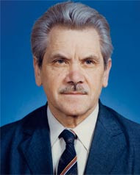
Anatoly Chernyaev
(1921-2017)
*
Clearly, the above information was of some importance. For Finland, it was sensational. It showed that a man who was about to stand for President in 1994 had engaged in “confidential cooperation” with Moscow while serving as Prime Minister, Minister of Foreign Affairs and leader of the country’s largest political party.
He was, it seemed likely, “Moscow’s man” in the Socialist International, where as vice-chairman, he would have exerted considerable influence. Let us recall that period, the last contortions of the Cold War. The streets of Western capitals teemed with “peace” demonstrations, protesting against NATO plans to locate medium-range nuclear missiles in Western Europe. At the centre of the campaign were European socialists and social democrats, many of them in government or, at least, leaders of the main opposition party. And at the very heart of it all, coordinating the Socialist International’s activities on matters of detente and disarmament while, at the same time, “confidentially cooperating” with the CPSU on these same issues, was Sorsa. In the run-up to the Finnish presidential election, one might think, such a revelation would have been seized on by the press. Yet this document was offered to the largest newspapers in Finland without any success. Only after six months, thanks to the efforts of my friends, did the information it contained finally appear in July 1993 in a major Finnish newspaper (“Archives show that Sorsa had Moscow’s special favour”, Ilta Sanomat, 10 July 1993). Having publicly expressed his regret, Mr. Sorsa withdrew his candidacy.
I could find no explanation for such a state of affairs. “People are tired of the Cold War”, I was told, and did not want to hear anything about the recent past. Was it for the press to decide what the public should or should not know about their future president? Surely the press had a duty to inform the public, and then let the public decide for itself what it did or did not need to know. Beyond a doubt, had the information concerned a putative president’s love affair or some petty corruption, it would have made front-page headlines in every Finnish newspaper.
Not so very long before there had been an enormous scandal in another neutral European country. It became known that Kurt Waldheim, who was running for president of Austria, had “cooperated confidentially” with the Nazis, some fifty years earlier, as a junior officer in the German army. The electorate, as it happened, chose to ignore the fact, but the Austrian press felt obliged to discuss the matter down to the smallest detail. The whole world raised a storm of protest, and everywhere the media treated it as an event of primary importance.
In that instance, strangely, nobody thought to say: “Why bother? Who cares?”
xxx
Finland, it could be argued, was a special case, as the term “Finlandization” indicates. The whole country had engaged, in some sense, in “confidential cooperation” with Moscow. For the Finns, this was not a crime and hardly a sensation. What else could one expect of a small, neutral country forced to live side-by-side with Big Brother? Yet geography was not the crucial factor. Norway was also a neighbour of the Soviet Union but it did not become “Finlandized”. The term, moreover, was coined in 1961 in West Germany, a far from neutral country, which (unlike Finland) the West was committed to defend. It was there that the process of “Finlandization” took root and flourished.
Despite a readiness to open the Stasi archives, a re-united Germany stopped short of putting the former East German leader on trial, no doubt fearing that Honecker would live up to his threat and tell a great many entertaining stories. No one was particularly keen to delve more deeply into the origins of the “Ostpolitik” of the 1970s, to re-evaluate that policy, or take a new look at the past activities of such figures as Willy Brandt and Egon Bahr. There was much that deserved closer scrutiny. The KGB passed a memorandum (9 September 1969*, No 2273-A), marked Top Secret (Special File), to the Central Committee reporting on a meeting in the Netherlands, between “a KGB source and Count Georg-Volkmar Zedtwitz von Arnim, a director of the Krupp corporation” at the latter’s request:
“Zedtwitz is a confidant of Egon Bahr, a prominent member of the German Social Democratic Party [SPD]. Bahr handles the planning, coordination and development of key aspects of West German foreign policy. Zedtwitz had approached the source, he stated, at Bahr’s direct request in the hope that the contents of the discussion would be relayed to the Soviet leadership. Citing Bahr, Zedtwitz said the following:
“The “most sensible” leaders of the SPD have reached the conclusion that it is essential to seek new ways of conducting the “Ostpolitik”. They wish to establish direct and reliable channels of contact with Moscow. In the opinion of some in West Germany, recent official contacts have yielded negligible results because each side, due to its official position, has done little more than make “purely propagandistic” declarations. Contacts with embassy officials in Bonn are also undesirable: it is difficult to maintain them unofficially, and information about any meetings provides immediate ammunition for the political opposition.
“In view of this, Bahr feels it would be desirable to conduct a series of unofficial negotiations with representatives of the USSR, which would place neither side under any obligations should the talks yield no positive results.
“Zedtwitz states that there are forces within West German industrial circles that are ready to facilitate a normalization of relations with the USSR. Their capacity is limited, however, because economic ties between West Germany and the USSR are still in an “embryonic” condition. In Zedtwitz’s opinion, the Soviet Union is not making sufficient use of the levers of foreign trade to achieve its political goals, though it would already be possible to ensure that measures are taken to exclude the participation of German specialists in the Chinese missile and nuclear programs and to counteract West German politicians’ tendency to flirt with Mao Tse Tung.
“According to available data, the leadership of the other ruling party in West Germany, the Christian Democratic Union, is also attempting to establish unofficial contacts with Soviet representatives and has expressed a willingness to conduct “a broad dialogue to clarify many issues for both sides”.
“Analysis of information we have received indicates that the two leading and competing West German parties fear that their political opponents will seize the initiative and put relations with the Soviet Union on a regular footing, and are prepared to conduct unofficial negotiations, not announced in the press, which could serve to strengthen their situation and prestige [the SPD and CDU were then coalition partners in government, tr.].
“Consequently, the KGB feels that it would be appropriate to continue unofficial contacts with the leadership of both parties. As such contacts develop, it would be advantageous, using the opportunities provided by our foreign trade, to try to exert a favourable influence on West German foreign policy, and ensure a flow of information about the positions and plans of the leadership in Bonn.
“We request authorization.
“KGB CHAIRMAN, ANDROPOV”
This is not just an interesting text, it was a historic document. It marked the beginning of the famous “neue Ostpolitik “, West Germany’s new policy towards its eastern neighbours, which subsequently became a fundamental component of “detente”, the most shameful chapter in the history of the Cold War.
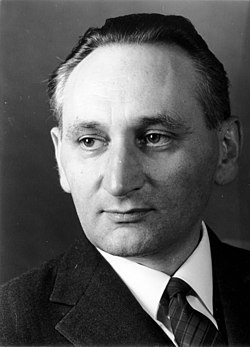
Egon Bahr
(1922-2015; 1969 photo)
*
The Federal Republic was then under no threat. It gained nothing substantial from this policy, but, as a consequence, East-West relations long became infected with the virus of capitulation. Because of this change in direction, instead of the united opposition to Communism of the late 1940s and early 1950s, the West was forced, at best, to waste its energies on a fruitless struggle with such a defeatist tendency and, at worst, to retreat to preserve its unity. This document determined the course of international politics for the next 25 years, yet no major newspaper in Germany was willing to publish it.
Three years after I had offered the text for publication, the German weekly Der Spiegel quoted some passages (“Pact with the Devil: Egon Bahr’s back-channel to the Kremlin”, 13 February 1995), without seeking my consent or mentioning the source. The publication prompted no reaction, and met with total indifference.
Was no one interested? Now that Communism had collapsed in Russia and Eastern Europe, did we feel neither desire nor duty to examine the circumstances under which the policy of détente was foisted upon the world? Had we no curiosity about the motives of its creators, the German Social Democrats, or about the damage it did to NATO’s collective defence? Did we really have no inclination to assess the damage this policy caused to the people of the USSR and Eastern Europe, by extending the lives of their Communist regimes for at least another ten years?
And what of the Social Democrats themselves? Did they feel no need to make an honest assessment of their policy towards the East? Ironically, the architects of the new “Ostpolitik” were touted as heroes who claimed that the downfall of Communism in the East was a result of their “subtle” engagement with Moscow. It was shameless beyond belief. On such criteria, Neville Chamberlain could have been declared the victor in 1945 since peace with Germany had finally been achieved.
xxx
Japanese Socialist Party
Another example from another country. Throughout the post-war decades, Japan was also shielded by the American nuclear umbrella. This did not prevent the country’s Socialists from receiving illegal financial aid from Moscow through the companies and cooperatives they controlled (R 31 October 1967, St 37/46), organizations tactfully described in Central Committee documents as “Firms run by the Friends”.
One might imagine that the largest opposition party in Japan, with many deputies in parliament and wide public support, could have maintained its financial independence. Instead, the Socialist Party became mired in debt to the tune of some 800 million yen and in 1967 turned for help to the CPSU. After pulling off some shady deals in timber and textiles, the party was hooked. In a few years, the Japanese Socialists were receiving funds from Moscow for their election campaigns (R 3 March 1972, St 33/8). It is not too difficult to guess what would have happened to Japan if they had won the elections. Perhaps a new term, “Japanization”, would have been born.
The actions just described were a crime under Japanese law, yet the documentary proof did not stir the interest of either the Japanese press or the country’s prosecution service. If it had been a matter, on the other hand, of illegal kickbacks to a political party from Japan’s own businessmen… About the same time The New York Times treated its readers to an “astonishing” scoop (“CIA spent millions to support Japanese Right in the 1950s and 1960s”, New York Times, 9 October 1994). The CIA, it reported, provided funds to Japan’s Liberal Party in support of its struggle against growing Communist influence. It was a sensation and something for the American reader to deplore. The same New York Times showed no interest when I offered them documentation concerning more recent Soviet aid to Japan’s Socialists. From the newspaper’s point of view, it was nothing to shout about.
And so, from country to country, document to document.
People didn’t want to know: for some it was all over and done with, for others it was not yet safely in the past. At one time, many feared to make such revelations — Communism was too powerful. Now, supposedly, it was so weak that such things were not worth knowing. There was either “too much” or not enough information … A thousand and one reasons were offered, each more unconvincing than the last, but the result was always the same. Apparently serious, honest people were overcome by embarrassment. With a conspiratorial wink, they would say, “Unfortunately, this isn’t enough. Now, if you could get hold of this or that further document…” For some reason, I was the only interested party and the onus, therefore, fell on me to find or furnish the evidence. It was as if I was persuading them to do something disreputable and they seized on a convenient excuse to decline my request.
If we had been discussing certain more distant events, one can assume there would have been no need to persuade anyone or to offer any additional proof. To bring those who took part in Nazi atrocities to justice was a sacred task, the duty of one and all. Yet God forbid that you should point a finger at a Communist, let alone a fellow-traveller: that would have been improper, and constitute a “witch-hunt”. The duplicity was astounding. When and how had we let ourselves become bound by this flawed morality? How had humanity managed to survive decades with such a schizophrenia of the conscience? Untroubled by any humanitarian doubts, we continued to hunt down senile 80-year-olds in Latin America because of the evils they perpetrated fifty years before. They were murderers and could not be forgiven. Never again, we proudly declared (and a noble tear moistened the eye). When it came to putting Honecker in the dock – the East German leader on whose orders people were being killed only a few years earlier – every feeling was outraged. It would be inhuman, he was old and sick. So, he was released and took himself off to die … in Latin America.
It was all part of something I call world-wide “Finlandization”.
*
1.2 Hard currency
These unthinking double standards transformed Western Communists into a privileged group, akin to sacred cows. They could do what they liked. They received advance forgiveness for any underhand behaviour or for committing crimes that would send an ordinary person to prison for years. For instance, they lived on Soviet money, although this was hotly denied; it was “not done” to speak of it in public. Now there were documents and receipts. The details of how this money was transferred to them via the KGB was described in the Russian press. In Western newspapers, a tacit ban on the subject remained in force.
It was puzzling. I was referring not to the Communist International in the years before the Second World War – that period was thoroughly documented by then, and, perhaps, no longer of great public interest: I was talking about our own times. Those who took part in such “activities” were still alive and should be made to answer for their deeds. In countries where it was not considered a crime to receive foreign funding for political activities, the receipt of such tax-free donations could not be overlooked. It was tax evasion which landed Al Capone in prison; Nixon’s Vice-President Spiro Agnew was forced to resign for similar offences. Yet not a single country in the world investigated the financial operations of local Communists, although there had clearly been systematic chicanery on a substantial scale.
Communist Party of the Soviet Union
At the end of the 1960s, to bring some order into the distribution of such assistance, Moscow created a special “International Fund to Aid Left-Wing Workers’ Organizations” with a total budget of $16,550,000 in annual contributions. Naturally, the USSR was the largest donor. The Politburo decided it would give $14 million. The fraternal East Europeans also chipped in (8 January 1969*, Pb 111/162): the Czechs, Rumanians, Poles and Hungarians provided half a million dollars each; Bulgaria gave $350,000, and the East Germans supplied $200,000. Of the 34 recipients that year, the biggest were the Italian Communist Party ($3.7 million just for the first six months!), the French Communist Party ($2 million) and the US Communist Party ($1 million). The smallest recipients were the Mozambique Liberation Front ($10,000); and Comrade Vikremasithke, Chairman of the Sri Lankan Communist Party, who received $6,000.
The Fund continued to operate until 1991. The only changes were in the number of recipients – by 1981 they had grown to 57 – and, for example, the amount paid to the US Communist Party: in 1981, it received $2 million (29 December 1980*, Pb 230/34). By 1990, the last year of the Fund’s existence, its budget had swollen to 22 million dollars, and the beneficiaries were 73 “Communist, workers’, and revolutionary-democratic parties and organizations”. The Soviet contribution to the “International Fund” increased correspondingly. By the 1980s, the Soviet share was $15.5 million, in 1986 $17 million, in 1987 $17.5 million and, in 1990, the entire $22 million. With the deepening crisis of Communism, the East European comrades defaulted on their contributions, one after the other, leaving Big Brother to pick up the bill for revolution. There was certainly cause for concern, as Valentin Falin, head of the International Department, stated on 5 December 1989* in a report to the Central Committee:
“The International Fund to Aid Left-wing Workers’ Organizations has consisted, for many years, of voluntary contributions from the CPSU and several other Communist parties in socialist countries. By the end of the 1970s, however, the Polish and Romanian and (from 1987) Hungarian comrades ceased to participate in the Fund, citing difficulties with finance and hard currency. In 1988 and 1989, the Socialist Unity Party of [East] Germany and the Communist parties of Czechoslovakia and Bulgaria, without offering an explanation, declined to make the contributions expected of them, and the Fund consisted entirely of sums apportioned by the CPSU. In 1987, the share paid by the above-mentioned three parties constituted $2.3 million, i.e. around 13 percent of the total contributions….
“Parties which have regularly received specific sums of money from the Fund over many years rate this form of international solidarity very highly. They do not believe it could be replaced by any other form of assistance. Most these parties have already submitted substantiated applications for aid in 1990; some requested that the amount be increased substantially.”
An equally unsettling problem was the continuing decline of the dollar, which depreciated this form of “international solidarity” – the damned capitalists just couldn’t get their inflation under control. Hence the dilemma: the aim was to bring capitalism to its knees, but a weakening of capitalism made the Communists themselves suffer. What was to be done? A way out was suggested by Anatoly Dobrynin. Then head of the Central Committee’s International Department, he was the very same Dobrynin who, as Soviet ambassador to the USA, was lauded in liberal American circles as pro-Western and an enlightened person with whom one could “do business”. He simply proposed on 21 November 1987 that all payments should be calculated in the more reliable “hard-currency” rouble. The Politburo approved this suggestion (30 November 1987*, Pb 95/21). The Soviet contribution was designated as 13.5 million “hard” roubles for 1988 and for the following year, when the no less “pro-Western” Falin replaced his enlightened colleague as head of the International Department. Towards the end, however, worries about the dollar retreated into the background, as the fraternal East Europeans scattered in all directions. For the final year, 1990, the USSR State Bank (Gosbank) agreed to provide the entire 22 million in dollars.
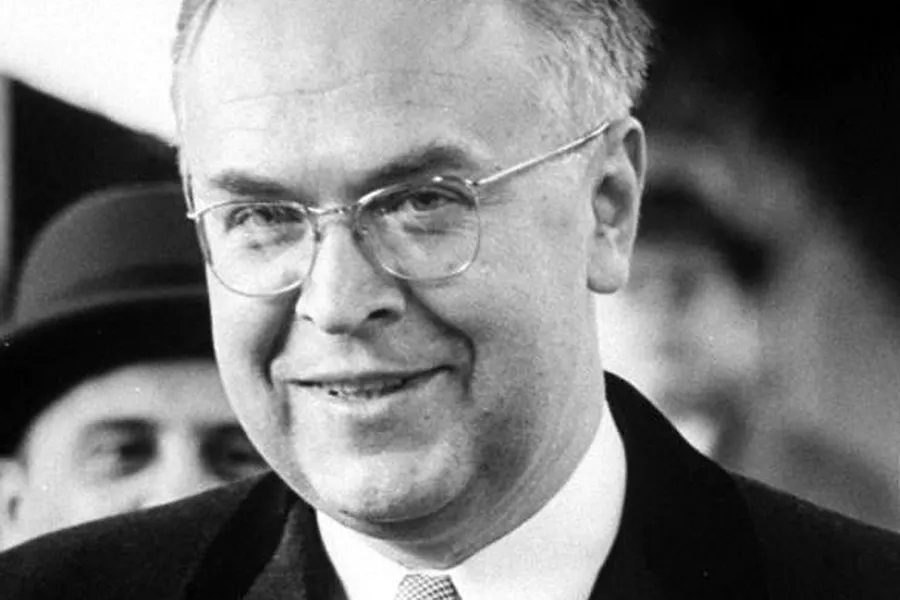
Anatoly Dobrynin
Obviously, the long years spent in Western capitals by Dobrynin, Falin and others had not diluted the Central Committee’s revolutionary fervour, and the approaching collapse of the Soviet empire did not undermine feelings of international solidarity. This is all the more curious when we remember that the Politburo which took these decisions headed by Mikhail Gorbachov, the most pro-Western, liberal and pragmatic Soviet leader with whom the West had ever “done business”. These “liberals” tried to sweep all trace of their activities under the carpet, so that the illegal export of foreign currency to Communist Parties around the world would not accidentally surface and undermine the West’s faith in “glasnost” and “perestroika”. By that time, the overriding concern of Kremlin “reformers” was to receive Western credits, and too much talk about where these funds went next could only damage that business.
They tried to replace the direct smuggling of hard currency with more refined financial schemes using “Firms run by the Friends” (below, 1.3). The suggestion was raised by the Politburo on 4 February 1987 and was the subject of a report by the International Department towards the end of the year (21 November 1987, pp. 6-9 in 30 November 1987*, Pb 95/21). It was discussed with their client parties but finally rejected. “The possibility of transferring aid through trade relations with firms controlled by fraternal parties is currently limited to a very small number of parties,” Anatoly Dobrynin reported to the Central Committee:
“Many firms controlled by Communist parties are economically weak, with limited contacts and capacity for trade; some of them are even losing money. The firms of only certain fraternal parties – the French, Greek, Cypriot and Portuguese – are in a position to develop cooperation with Soviet foreign trade organizations in a way which would bring them tangible profit. The percentage paid by firms into party budgets is, as a rule, insignificant – from 1 to 5 percent from profits or concluded contracts.
“The financial activities of firms or businesses controlled or owned by Communist parties are subject to hard scrutiny by taxation and fiscal bodies in their own countries. More or less significant payments by these firms into their Party coffers could become a cause for continual speculation by the bourgeois mass media. While not rejecting the possible receipt of aid through trade organizations, comrades from fraternal parties consider this method to be “harder to conceal and involves many risks” (Gaston Plissonnier, French CP).
“Parties which have, for a lengthy period, received regular aid from the International Fund for Aid to Left-wing Workers’ Organizations, are counting on the preservation of this form of solidarity. For some, first and foremost the underground organisations, income from the Fund is the only means of financing their activities; for others, aid from the Fund is a very important part of their resources for financing organizational, political and ideological work (including publication and distribution of newspapers and other printed matter).
“Ending assistance from the International Fund would, for most of the recipient parties, be an irreparable loss and inevitably have an extremely negative effect on their activities. Even parties which have their own businesses, trading and intermediary firms would have to cut back on at least some important undertakings without income from the Fund. In turn, this would lead to a decrease in their political weight and influence, and lessen their ability to influence social and political processes in their countries.
“At present neither the fraternal parties nor Soviet foreign trade organizations are ready to transfer financial assistance through foreign trade channels. For most parties this is simply unacceptable because they own no enterprises or trading firms. But they need financial aid more than ever.”
Clearly, the clients dug in their heels and had no wish to exchange revolutionary romanticism for the mundane concerns of commerce. Moscow, however, remained restless. The following year saw the whole circus repeated – the discussions, the reports to the Central Committee (this time by Falin), and its resolution. The same arguments were aired, only this time we learn in greater detail to what uses this aid was being put (28 December 1988*):
“The money received from the Fund is used by the parties, at their own discretion, for the main types of party-political work (the activities of the Central Committee, payments to full-time Party activists, publication of newspapers, hire of halls, election campaigns, etc.). The leaders of fraternal parties rate this form of solidarity very highly, and feel that it cannot be replaced by aid in any other form. This was reiterated recently by G. Plissonnier (French CP), who stressed that receipt of aid from the Fund in no way limits the independence of individual Communist parties in determining their stance on any political issue. At the same time, the cessation of this aid or its reduction would deal a great blow to the political activities of the parties, especially in matters concerning events of national significance (elections, congresses, conferences), all of which call for substantial expenditure.”
Moscow never did wean these Communist sucklings from her maternal breast or persuade them to adopt the principle of “socialist self-financing”, though attempts were made practically every year. In 1991, some six months before things fell apart, meetings continued with the afore-mentioned Gaston Plissonnier of the French Communist Party, as did discussions concerning “the development of business ties with the CPSU and suggestions concerning trade and economic relations via Firms of the Friends” (R 17 Jan 91 – No 6-S-44). It is not hard to calculate that such “international solidarity”, from 1969 onwards, provided the French Communist Party with no less than $44 million, the US Communist Party with some $35 million, while the Italians received still more. In total Moscow gifted its “Friends” around $400 million from 1969 onwards, and that did not include other forms of financial support. These were substantial sums – how could they be of no interest to Western bodies responsible for tax-collection, fiscal policy and the banking sector?
The West provided the Soviet leaders with hard currency to rescue the latest Kremlin “dove” from the clutches of surrounding Kremlin “hawks” (or, at other times, to save the “reformers” from the “conservatives”). This was how the money was spent. In the 1990s there were demands for the return of these funds, with interest, from the destitute peoples of the former USSR. Why didn’t every country claim payment of these debts from its own Communists? Would this not have been easier and more just? Penniless Russia would never be able to pay. The idea evoked no enthusiasm, however. For on closer scrutiny it would not only be the Communists in the dock.
*
1.3 “Firms run by the Friends”
Despite all their claims to poverty, aid from Moscow via “Firms run by the Friends” was a far from negligible addition to the budgets of the recipient parties. Unfortunately, I lacked sufficient documentation to paint a full picture of these activities. The materials at my disposal, however, were quite adequate for an estimation of its scale.
By the looks of it, one of the first Western Communist Parties to adopt the “socialist principle of self-financing” was that of Italy, at the time the largest and most influential in Europe. Looking through the lists of the International Fund’s clients (29 December 1980*, Pb 230/34) I had been concerned to note that by the end of the 1970s there was no longer any mention of the Italian comrades, although to begin with they had headed the list. “Poor souls,” I thought. “They must have suffered for their honesty and principles by refusing to abandon faith in ‘communism with a human face’, whereupon Moscow heartlessly deprived them of fraternal aid.”
Italian Communist Party
At that time, it is true, the Italian comrades were displaying feats of heroism. They distanced themselves from Moscow on the issue of human rights; they condemned the Soviet invasion of Afghanistan; and they came out in support of “Solidarity” in Poland. We disbelieving cynics thought this was no more than window-dressing. For a moment, I must confess, I felt ashamed of my cynicism. Alas, I could have spared my blushes – the Italian Communist Party had no intention of perishing from a surfeit of honesty. On the contrary, its contacts with Moscow deepened perceptibly. In summer 1980, the Politburo adopted a special resolution “On strengthening work with the Italian Communist Party” (R 10 June 1980, Pb 203/1 NA); a short while earlier they appear to have put their financial relations on a sound footing. At least, the following document (5 October 1979*, St 179/32), marked Top Secret (Special File), indicates they were in the process of doing so:
“At the request of Comrade E. Berlinguer a member of the leadership of the Italian Communist Party [PCI], Comrade A. Natta, Coordination Secretary of the PCI Central Committee, has informed us that PCI leadership member Comrade Gianni Cervetti, who arrives in Moscow on 7 October this year for a short vacation, has been instructed to discuss a number of special issues, including financial matters, with the CPSU Central Committee (coded telegram from Rome, No 1474, 3 October 1979).
“We feel it would be expedient to meet this request of the PCI leadership and receive Comrade G. Cervetti in the CPSU Central Committee to discuss the matters which interest him. A draft CPSU Central Committee resolution is appended.”
Naturally, one could only guess what financial matters were discussed at the Central Committee by Comrades Cervetti, Ponomarev and Zagladin. A few years later a highly-classified Politburo document (18 January 1983*, Pb 94/52) illustrated the nature of those financial relations – the amount in dollars was added by hand:
“Concerning the request of the Italian Friends
“Instruct the Ministry of Foreign Trade (Comrade Patolichev) to sell Interexpo (president, Comrade L. Remiggio) 600,000 tonnes of oil and 150,000 tonnes of diesel fuel on a normal commercial basis, but on favourable conditions at a discount of approximately one percent, and to extend the payment period by three to four months, so that our Friends will stand to gain approximately 4 million dollars from this commercial operation.
“Secretary of the Central Committee“
xxx
“The Cold War is over, haven’t you heard?”
How could one fail to hear when the news was shouted from the rooftops by those for whom that war never existed or who, at best, closed their eyes to its existence. “Desert Storm” in early 1991 had also come and gone but the investigation of firms which dealt with Iraq before the war was only just beginning. No war is over until the minefields and unexploded bombs have been cleared and the gangs of looters and surviving foes have been disarmed. Everyone knew that: the peace could otherwise prove a horror worse than the war itself.
Here, however, the rule of silence was broken. It was a significant exception, and it had far-reaching repercussions. In late 1991 and early 1992 these and certain other documents concerning the unsavoury past of the PCI began filtering into the Italian press. People started to talk of an investigation into possible violations of the tax laws. The reaction was instantaneous – those who suggested an investigation found themselves being investigated. It was as if the magistrates’ courts, actively infiltrated by the PCI in recent years, awoke abruptly from a deep and dreamless sleep to discover an astonishing degree of corruption in the financing of virtually all Italy’s major political parties – except, naturally, the PCI.
What followed can be likened to Stalin’s Great Terror of 1937-1938, if not in magnitude, then certainly in style: one third of the Italian Cabinet of Ministers found themselves in jail or under investigation. The terror went under the proud title of the “clean hands” (mani pulite) operation – hard not to recall the Chekist motto here,” A cool head, clean hands, and a passionate heart” – and it cut a swathe through the Italian establishment, sparing neither politicians, nor businessmen, nor government officials. Thousands were imprisoned. Arrests, almost invariably, followed information given by those behind bars in exchange for their own release. There were several suicides. As yet, admittedly, there was no torture or summary execution – the Italian Communists, after all, had “a human face”. A thriving country, Italy began to fall apart: the economy tottered on the brink of collapse, the rate of the lira plunged drastically, the machinery of government ground to a standstill, and unemployment soared. Who would now come to the rescue, who was worthy to rule Italy if not those with “clean hands”?
“But there really was corruption!” protesting voices cried. Yes, there was and – this was the crux of the matter – it had been present throughout the entire post-war period. Corruption was as widely accepted a transgression in Italy as exceeding the speed limit. Everyone knew about corruption, including the magistrates with their “clean hands”. Yet, for some reason, nobody bothered to fight it until the PCI came under threat of exposure and found itself on the verge of ruin without financial aid from Moscow. The Italian Communists really had nothing to lose but their chains, and the prize would be Italy. Just like their “clean-handed” Soviet predecessors of the Great Terror, however, they did not appreciate how easily terror, an ungovernable force, can turn on its perpetrators. Then they would be reminded of their trade with Moscow “on a normal commercial basis” and their self-interested control of virtually all Italy’s trade with the USSR, which funded the largest Communist party in Europe for decades.
Needless to say, other Communist parties traded with the CPSU Central Committee on the same “normal commercial basis” for years, but the example of what happened in Italy hardly encouraged public discussion of the matter. The French probably began earlier than their Italian colleagues. At least one document I found suggested this was likely: at the end of 1980 the Central Committee Secretariat approved a ten-year extension of payment on a loan of 2.8 million roubles made to the West German firm Magra GmbH, a company controlled by the “French Friends” (R 16 December 1980, St 241-99). In recommending this decision, the International Department of the Central Committee reported: “The firm Magra GmbH is owned by the French Communist Party, and for 15 years has been purchasing ball-bearings from the [Soviet] foreign trade organization Stankoimport for sale in West Germany. The debt of 2.8 million arose because the firm invested this sum in expanding their business and there was a fall in demand for ball-bearings in West Germany.”
From 1965, this firm and its French offshoot, Magra-France, successfully traded in Soviet goods for the benefit of communism. In Germany alone, ball bearings were sold to the tune of 10 million hard-currency roubles. Another document from the Central Committee (R 26 August 1980, St 225/84) referred to “suggestions put forward by G. Jerome”, a member of the PCF Central Committee, and instructs the Soviet Ministry of Foreign Trade and Gosplan to “devise and implement measures for further expansion of trade and economic ties with firms run by the French Friends,” such as Comex and Interagra. There were as many such firms as the “suggestions” nursed by Jerome. Clearly Comrade Plissonnier could have had little cause for complaint.
Nor were others left out. In far-off Australia, the Socialist Party pressed for the cancellation of “debts to the sum of 2,574,932 roubles, incurred by the Australian firm Palanga Travel for the charter of the cruise ships ‘Fyodor Chaliapin’ and “Khabarovsk’ in 1974-1975” (R 23 December 1980, St 242-76 NA). It is not clear whether this was a firm run by the Socialist Party of Australia (set up in 1971) or would become theirs in exchange for the debts being written off.
*
The Greek publisher and industrialist George Bobolas earned inclusion in the title of a Central Committee resolution (R 11 April 1980, St 206/58), “On cooperation with the Greek publisher G. Bobolas”, which instructed the Ministry of Foreign Trade and the State Committee for External Economic Ties “to give preference, all other things being equal, to Greek industrialist and publisher G. Bobolas, in view of the positive part he has played in the development of Soviet-Greek ties.”
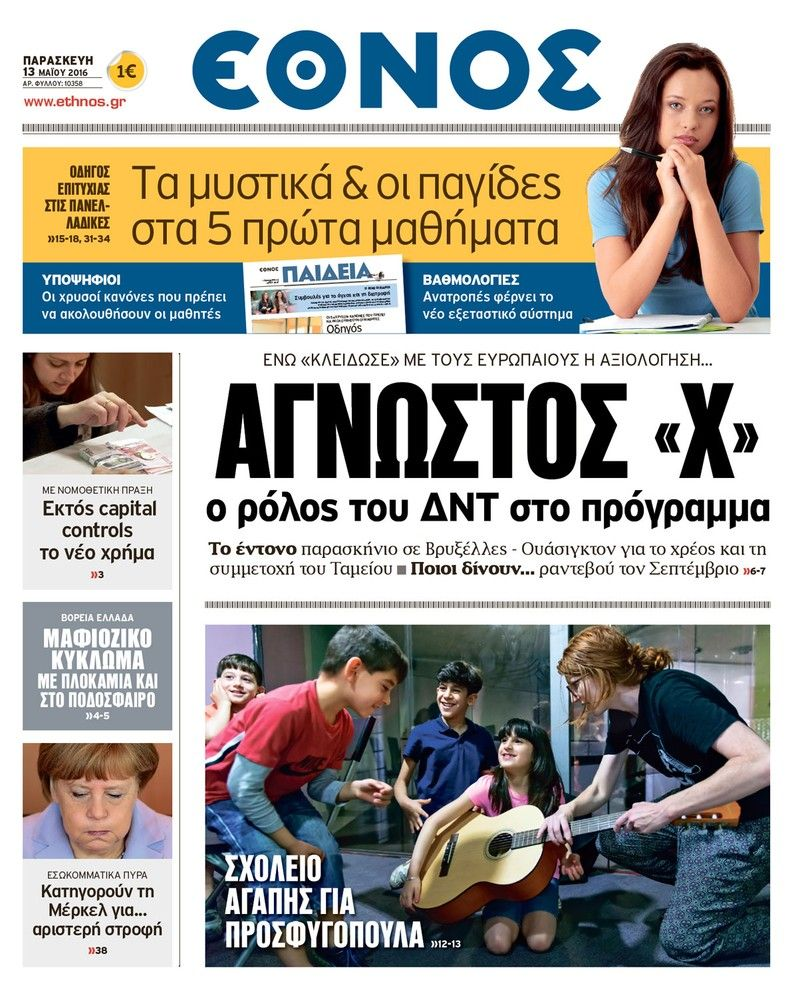
“Ethnos” weekly newspaper
At first glance, this did not seem too heinous. It was a small reward for the comrade’s tireless efforts in the cause of good neighbourly relations. From appended documents, however, and especially from the report submitted to the Central Committee by KGB deputy chairman S. Tsvigun, it emerged that these efforts fell within the framework of KGB “special measures”. The Chekists had their own understanding of good neighbourly relations. They used Bobolas’s publishing house Akademos as a “base for ideological influence in Greece and in the Greek communities of several [other] countries.” The devotion of Bobolas to promoting good neighbourly relations with the Soviet Union resulted in certain losses, in particular, those incurred in publishing a Greek translation of Brezhnev’s Peace – Mankind’s Best Reward with a foreword by the author. “To achieve a degree of compensation”, Bobolas was “seeking to establish business contacts with the Ministry of Foreign Trade and the State Committee for External Economic Ties through the conclusion of quite large-scale and mutually beneficial deals.” Subsequently there were several scandals involving Bobolas. Naturally, having received such strong “preferential status” in the conclusion of “mutually beneficial” business, he did not sit idly by, nor did he disappoint his Soviet partners. Within a couple of years, he began publishing the newspaper Ethnos, the main mouthpiece for Soviet disinformation in Greece. Attempts were made to expose him, but he fought back, taking The Economist to court for “libel” over a 1982 report. And he practically won the case.
Time passed, and George Bobolas grew from a building contractor into a media tycoon. Apart from Akademos publishers and the Ethnos newspaper, he became co-owner of Mega, the largest Greek television channel. Bobolas acquired interests in the cinema and recording industries, and successive governments – both socialist and conservative – continued to give him huge construction contracts. In other words, he was seen as a respectable citizen, and a pillar of society and Greek democracy. In time the good neighbourly regime in Moscow collapsed. The newspaper Pravda found itself bankrupt and on the verge of closure. For some time, it disappeared from the newspaper stands. Then, suddenly, it again sprang to life and began to flourish, as was reported, thanks to “funds provided by Greek Communists”. Officially, Pravda‘s fairy godmother was named as one Yannikos, a partner of Bobolas in his past publishing feats.
It was anybody’s guess how many such “Bobolases” Moscow spawned over the past 75 years. Who were Armand Hammer and Robert Maxwell: businessmen who became agents, or agents who became businessmen? Where did business end and politics begin? No businessman could have had purely commercial relations with the USSR, of that I remain firmly convinced. One cannot deal with the devil without becoming his servant. Leaving aside the dubious morality of selling the “hangman of the bourgeoisie” the rope he needed, it was hardly possible to fraternize with the Soviet demons without becoming corrupt. Moreover, the people who then sought such relations were a particular breed and held particular views.
*
A straightforward document, apparently devoid of any secrets, concerned: “Opening offices in Moscow for a number of foreign companies” (R 5 January 1981, St 244/50 NA).
At first glance, there seemed no reason to be suspicious: these were, surely, established firms with large turnovers, trading on the basis of “mutual benefit”. Yet this document was also classified “Top Secret”. A closer look at the attached résumés showed that one firm had a prominent Western politician on its board of directors, while another helped to influence the policies of its government “in directions favourable to our interests”. A third firm, the Spanish company Prodag S.A., was an absolute paragon. Prodag paid its bills on time, it had been trading with the USSR since 1959, and it was a dependable partner: “figures for 1979 show that some 50% of all trade between Spain and the Soviet Union was conducted through Prodag.” Only the last line shed a glimmer of light: “the firm’s president, R. Mendoza, is currently preparing L.I. Brezhnev’s work Peace, Disarmament and Soviet-American Relations for publication.”
By 1981, according to this Top-Secret document, 123 such offices had opened in Moscow. Who could say what they were doing when not engaged in commercial activities? Why did they need offices in Moscow during that period? Were they still there in the 1990s? How many other firms dispensed with such official representation? Nobody was trying to find out. What difference did it make now? “Who cares?” All this was in the past.
*
Meanwhile, the issue of firms which traded with the Soviet Union became increasingly significant. During Gorbachov’s last few years in power, especially in 1990-1991, he “privatized” the activities of the CPSU, encouraging the apparatus and, especially, the KGB to set up so-called joint ventures with Western businesses. Their numbers grew astronomically and, presumably, this was thanks in the first place to “Firms run by Friends” and other “businessmen” allied to the KGB. Such a scenario seems quite logical, given Gorbachov’s determination to put “international aid” on a commercial footing. Who better for the KGB to deal with than those it already knew and could control?
They began by laundering Communist Party funds and looting the country’s natural resources (gold, oil, rare metals). Spreading like cancer, these malevolent, Mafia-like structures then gained a stranglehold over practically all “private” enterprise in the former USSR. Russia, Ukraine and the other Soviet republics joined the world market, adding another international crime syndicate, more powerful and frightening than the Cosa Nostra or any Colombian drug cartel.
*
1.4 Intellectual Shenanigans
Not surprisingly, Moscow’s aid to its clients was not restricted to that described above.
As Falin reported to the Central Committee in the late 1980s (28 December 1988*), apart from direct subventions and finance via commercial channels, there was also: “supply of paper for newspaper printing; invitations to party activists to study, take vacations and receive medical treatment [in the USSR]; purchase of the parties’ publications; payment of some party representatives’ travel from one country to another, etc.”
The “etc.” included, for instance, a whole network of bookshops owned by “Friends” in many countries. This program, instituted in the 1960s via the “Mezhdunarodnaya Kniga” (International Books) foreign-trade agency, was not cheap. All these shops were opened with Soviet funds in the form of credits which, naturally, were never repaid in full. They all “traded” at a heavy loss which would later be written off “at the request of the Friends”. The cost varied, depending on place, time and circumstance. The re-opening of Collets Bookshop in the centre of London, for instance, cost Moscow £80,000 (or 124,000 hard-currency roubles), and the contract with the firm explicitly envisaged “covering a possible deficit from the sale of Soviet publications in the first years of the shop’s existence”. (The wealthy British Communist Eva Collet Rickett financed left-wing bookshops in London, Hull, Cardiff and Glasgow from the 1930s onwards. Following her death, the new agreement secured the future of Collet’s Bookshop in London on the Tottenham Court Road {3 February 1976, St 203/10 NA}.)
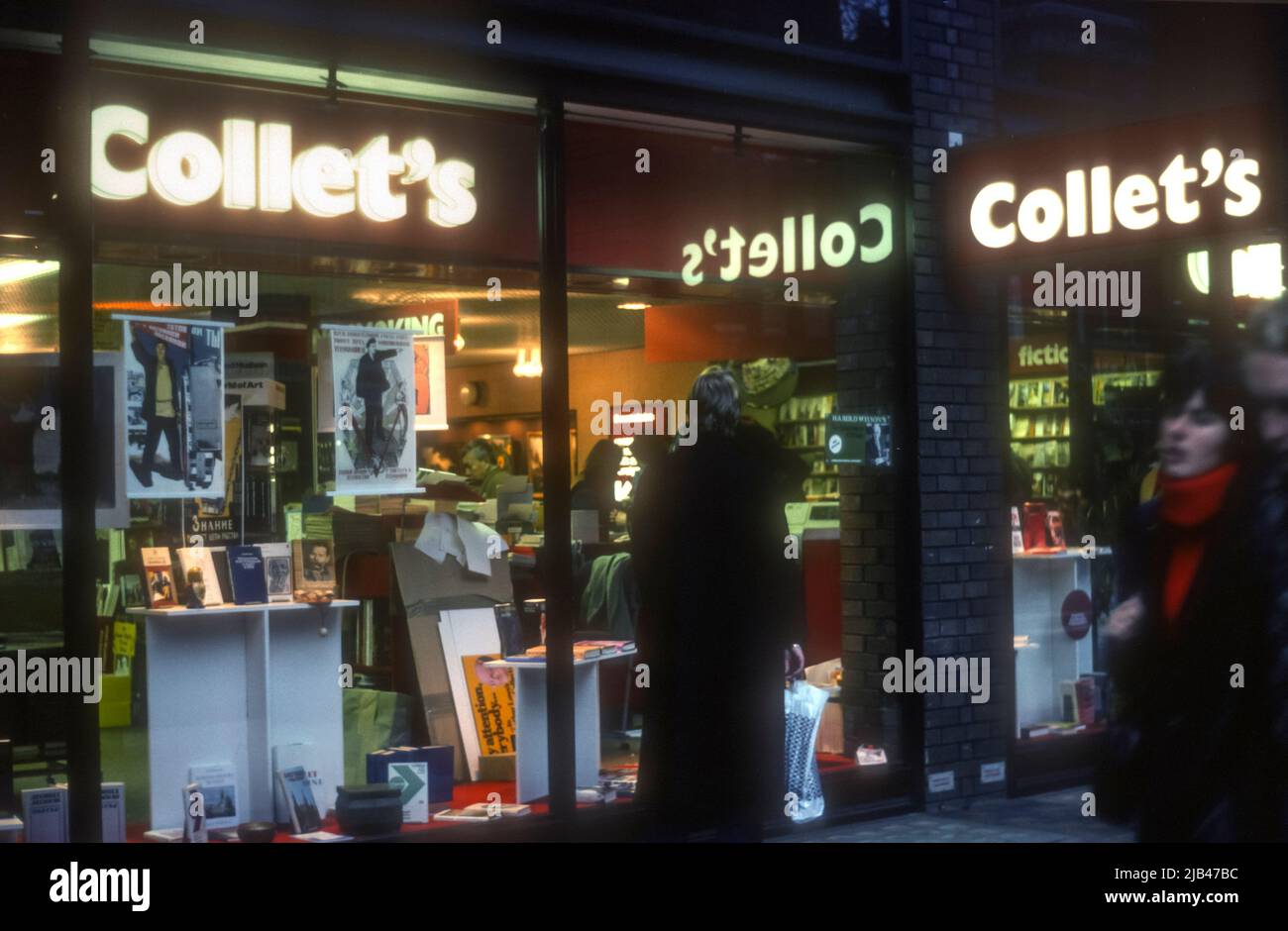
Collet’s Bookshop (London)
The opening of a similar shop in Montreal a few years earlier had cost only 10,000 Canadian dollars. The total debts written off in the late 1960s varied. They ranged from 12,300 hard-currency roubles for the Israeli Communist Party’s Popular Bookshop and 56,500 hard-currency roubles for the Belgian Communist Party’s shop “Du monde entier”, up to $300,000 in 1968 for the firms run by the US Communist Party (“Four Continents Book Corporation”, “Cross World Books & Periodicals” and “Victor Kamkin”) [R 15 April 1968, St 50-148]. Australia was not forgotten: by 1978 the Socialist Party’s “New Era Books & Records” owed Moscow 80,000 hard-currency roubles.
Without full information, it is hard to determine the overall loss from this bold commercial activity. The report submitted by Mezhdunarodnaya Kniga to the Central Committee in 1967 showed that the total volume of the firm’s “exports to capitalist countries” was worth 3.9 million hard-currency roubles for that year; the overall sum of deferred debts was 2.46 million, while bad debt amounted to 642,000 hard-currency roubles. These were considerable sums at the time. Nonetheless, the exports continued. By the early 1980s there was a new series of debts to be written off, including $460,000 owed by “Imported Publications” and “International Publishers”, other firms run by the US Communist Party (R 5 January 1982 – St 44-7).
Then there was paper for fraternal publications, supplied gratis and in enormous quantities. The decision to establish a special fund for this purpose was taken by the Central Committee in the mid-1970s (R 28 May 1974, St 126/7 NA) . It was impossible to estimate how much the Soviet Union spent on such matters since the cost of producing and transporting anything in the USSR was not evaluated in real money but arbitrarily expressed in “non-cash transfers”. It was, in simple terms, a bottomless well. In 1980 alone this special fund supplied the brothers abroad with 13,000 tonnes of paper (R 15 October 1980 (St 233/8 NA). I had no idea how much this would cost in the West but a rough estimate based on a provisional assessment of the costs yielded a figure of 3.5 million roubles per annum. Finally, as of 1 January 1989, the fund ceased to exist. The Soviet Prime Minister, Nikolai Ryzhkov, instructed that “Expenses relating to the production and supply of newsprint covered by the special fund set up to meet the needs of fraternal parties will now be covered by USSR budget allocations for aid to foreign countries” (R 24 Dec 88, No 578). Probably we shall never learn exactly what this cost a country where toilet paper was a luxury and the shortage of paper for printing so acute that one had to submit 20 kilos of books and newspapers for pulp to be sure of getting a new title that would be in heavy demand.
But that was not all. There was yet another form of aid for fraternal publishing: the direct purchase of this output by the Soviet Union, allegedly for sale to foreign students and tourists in the USSR. Again, I had no systematic, year-by-year information on the subject, but as the crisis deepened the Soviet authorities were forced to review all their revolutionary expenses. By the late 1980s the purchase and transportation of 90 titles from 42 countries consumed 4.5 million hard-currency roubles per annum – around $6 million at the exchange rate of the time.
The “living expenses” of Moscow-based correspondents for these fraternal publications also formed part of the bill. From the late 1950s, to disguise its origins, this bill was footed by the Soviet Red Cross. As the crisis of the 1980s escalated, the unthinkable happened: the Red Cross rose up in arms and refused to pay, citing government cuts to its own budget as the reason (6 February 1990*, St 10/1). When the expenses were totted up, the result was astonishing:
“At present, there are 33 foreign correspondents in Moscow, who occupy 33 apartments, including 7 bureaus. Apart from their salaries, their postal, telegraph and telephone costs are paid, as are the renovation costs of apartments and offices, travel within the Soviet Union and abroad, access to medical treatment and the use of resort facilities. Practically every correspondent is assigned a secretarial assistant, whose salary is paid by the Executive Council of the Soviet Red Cross and Red Crescent Society. In 1989, the expenses arising from the presence of this category of foreign correspondent exceeded one million roubles.”
It became necessary for the Central Committee to review this form of international solidarity, too.
This related only to “foreign correspondents”. There was also the cost of looking after visiting Communist leaders, who were received in much grander style. In those days, it should not be forgotten, medical treatment, housing and education were all considered free of charge in the Soviet Union and thus were not included in the arithmetic. Nonetheless, in 1971 alone the hospitable Central Committee assigned 3.2 million hard-currency roubles in the expectation of receiving 2,900 very dear guests, of whom at least one hundred were expecting to receive medical treatment (28 July 1971*, St 123/30).
*
There were also services which cannot be measured in either dollars or hard-currency roubles. I uncovered a handwritten request sent by Gus Hall, the General Secretary of the US Communist Party, in October 1969 on behalf of Comrade James Jackson, a leading Marxist thinker and main theoretician of the Party, who was very keen to be awarded an honorary doctorate in history. Surely this should not be too hard to arrange, say, with the Moscow State University? Why, of course not, comrades. No problem whatsoever! As noted in the accompanying memo from the International Department (R 1 October 1969, 25-S-1765), not only would this serve “to raise his authority in democratic negro circles”, it would also “make it possible for him to secure a teaching post at New York University, where the Party has lately been working actively.” It paid to have Friends in the right places. The President of the United States could not make you a professor at New York University; the Politburo could.
US Communist Party
These more innocent Communist shenanigans did receive some coverage in the Western press. The documents themselves were not cited but there was passing reference to them in some newspapers, mainly in humorous form: Look at those silly Russians, fancy throwing money away on such nonsense. Moscow’s assistance to the US Communist Party was regarded as the biggest joke of all: why on earth was it necessary? There were only 40,000 Communists in the entire country. The newspapers’ amusement, however, was wide of the mark. Moscow needed the US Communist Party not for elections to Congress but for a quite different reason. This was not a party in the traditional sense but, rather, a paid Soviet network of agents, and having 40,000 agents in your enemy’s midst is no mean achievement. Back in 1917, Lenin also started out with only 40,000 comrades.
As for the books, newspapers and magazines, there was not much to laugh at, either. Following in Lenin’s footsteps, they all began with the printed word and ended with terror. Here in a Top Secret (Special File) memorandum from the KGB to the Central Committee is one example of what the US Communist Party was up to at the time (28 April 1970*, 1128-A).
“Of late the radical negro organization the Black Panthers has been subjected to harsh repression by the US authorities, headed by the FBI, which regard the Black Panthers a serious threat to national security. Police provocation, the trials of the Black Panthers and the wide coverage of the terrorist actions of the authorities against the activists of this organization have resulted in a significant growth of the Black Panthers’ prestige in progressive circles in the US.
“In view of the circumstance that the Black Panthers are a dynamic negro organization which poses a serious threat to America’s ruling classes, the Communist Party of the USA is attempting to influence the organization in the necessary direction. This policy of the CP is already yielding positive results. There is a discernible tendency among the Black Panthers to increase cooperation with progressive organizations which are opposed to the existing system in the USA.”
The KGB suggested it would be “advisable to implement certain measures aimed at supporting this movement and assisting its growth” because the rising protests would create “certain difficulties for the ruling classes of the USA” and, more specifically, would “distract the Nixon administration from pursuing an active foreign policy”. The KGB therefore requested authorisation to use its “assets” in African countries
“to incite political and public figures, youth, trade union and nationalist organizations to put forward petitions, and submit demands and declarations in defence of the rights of American negroes to the UN, to US embassies in their countries and to the US government; to publish articles and letters in the press of various African countries, accusing the US government of genocide. Use KGB assets in New York and Washington to influence the Black Panthers to address appeals to the UN and other international bodies for assistance in bringing the US government’s policy of genocide towards American negroes to an end.
“By implementing the above-mentioned measures, we believe, it will be possible to mobilize public opinion in the US and in other countries in support of the rights of American negroes and thereby stimulate the Black Panthers into further activation of their struggle.”
… Like a murky dream, I recalled my cell in Vladimir Prison, and Pravda headlines screaming: “Free Angela Davis!” When you had been sentenced to 7 or 10 years’ imprisonment for reading a proscribed book or for one word of criticism it was comical to read this. To those of us schooled by prison, the scenario was crystal clear: it was a straightforward case of being an accomplice to murder. She gave her Black Panther boyfriend the weapons with which he killed court officials and policemen, while attempting to escape. What could be simpler? But the world was going mad: she was “a courageous woman”, an “activist of the negro movement”.
Frightened lawmakers in California abolished the death penalty in their state, to be on the safe side, and the no less frightened members of the jury cleared Davis of every charge, to the delight of all progressive mankind. She was a latter-day Vera Zasulich, no less! Only much later, after the court had acquitted her, did Pravda proudly refer to “Angela Davis, member of the Central Committee of the US Communist Party “. They could get away with anything, including murder.
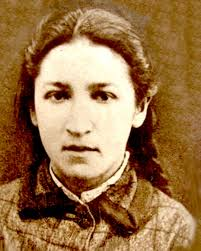
Vera Zasulich
(1849-1919)
Chapter 1: A Phoney War (part two) …
=======================================

