The regime’s most ludicrous violations of the law occurred when it did not wish to imprison us or, at least, punish us “with the full force of the law”. The search for alternative forms of reprisal led to a malfunctioning of the Soviet punitive system.
Ideological expediency could not be combined with legality, and this led to extraordinary paradoxes obvious to those with no knowledge of the law. Was there anyone, for example, who did not know when we were expelled from the USSR, “exchanged” for Soviet spies, or deprived of our citizenship? No one doubted these were politically-motivated reprisals without any foundation in law.
*
4.1 “Without the latter’s consent …”
Anatoly Marchenko and Ilya Gabai had been formally expelled from the country, as we have seen, when the authorities had second thoughts. No trouble was taken to revoke the edict depriving them of their Soviet citizenship (15 April 1968*, Pb 79/XII).
The decision was no less arbitrary in other cases.
Valery Tarsis
Valery Tarsis was the first person in the post-Stalin period to be deprived of his citizenship for political reasons. Having let him travel to Britain the Politburo was undecided what to do next. Then the KGB reported: it had managed to discredit Tarsis in the West (R 8 April 1966, Pb 238-132):
“The KGB is continuing its measures to further compromise Tarsis as a mentally ill person.
“As concerns the defamatory anti-Soviet statements made by Tarsis abroad, and the positive reaction of Soviet citizens to the measures taken against him, we do not consider it expedient to permit his return to the Soviet Union, and propose that Tarsis be deprived of his Soviet citizenship and denied entry to the USSR.”
The Politburo agreed and the Presidium of the USSR Supreme Soviet issued the appropriate edict. Yet what if Soviet citizens had expressed a “negative reaction” to these measures: would Tarsis then have retained his citizenship? And how should such reactions find expression? More fantastic still, from a legal point of view, were the “exchanges”, especially when certain Soviet citizens were exchanged for others (24 April 1979*, Pb 150/129 p. 8):
“On 27 April 1979 the KGB, in accordance with Central Committee Resolution No P129/44 (16 November 1978), deported the criminals Vins, [Eduard] Kuznetsov, Dymshits, Moroz and [Alexander] Ginzburg (who have been deprived of their citizenship by the Presidium of the USSR Supreme Soviet), to the USA in exchange for Soviet intelligence agents Comrades Chernyayev and Enger, who were convicted by the American authorities.
“At the same time the Jewish nationalists [see CCE 17.6-1] Altman, Butman, Zalmanson, Penson and Khnokh quit the USSR, having been given permission to leave in view of the operational situation within the country as it prepares for the Olympic Games in Moscow.”
As if this were insufficiently comic, the head of the KGB added (24 April 1979*, Pb 150/129, pp. 8-10) that his organisation had received information
“… that the expulsion from the USSR of the above-mentioned persons is assessed by anti-Soviet groups abroad and anti-social elements within the country as a serious blow to their plans to “weaken socialism from within”. In commentaries made abroad it is emphasised that in Vins, Kuznetsov, Altman and other anti-Soviets the West has lost “reliable executors” of the hostile schemes of secret services and subversive centres, and sources of spiteful defamation of Soviet reality and the domestic and foreign policies of the Communist Party and the Soviet government….
The deported individuals themselves give a similar assessment. Ginzburg and Vins, for example, have declared that it would have been better for them if they had not been expelled and remained in prison so as to maintain contact with the milieu in which they were working.”
Valentyn Moroz (1936-2019)
This was written at a time when tens of thousands were trying unsuccessfully to leave the Soviet Union. Many of those “expelled” were imprisoned precisely because they wanted to go to Israel. A contemporary cartoon in The New York Timesshowed two foreigners in fur coats and hats, chatting on Red Square: “Well, everything’s clear now,” says one to the other: “those who want to go, are not allowed out; those who don’t, are forced to leave.”
*
In fact, all those “expelled” were, at the moment of the exchange, being held in camps or prison. If a radical improvement to the “operational situation” was the true explanation they should have been expelled immediately, without bothering the investigators or the courts. All the other “reliable executors of hostile schemes” (and all political prisoners, why not?) could also have been added to their number. Especially since the “subversive centres” declared that this would be a “serious blow” to their work.
It’s amusing in retrospect but that, roughly speaking, was the situation. In 1970-1, before my last arrest, I recall how I helped several Jewish activists, whom the Soviet authorities would not release, to emigrate. Legends began circulating among the refuseniks about my special skills but I did not divulge my methods. They were very simple. Taking pity on one such refusenik I proposed to make him my “accomplice” and put on a little show for the KGB. He was to ring me up regularly and repeat certain mysterious phrases; or he would come and visit me, secretly, at home. Sometimes he would show up with me in company, we would talk about something with a business-like air, and then, having received his instructions, he would rapidly disappear. Usually only a month of these games were needed before my accomplice received permission to leave the USSR ahead of the queue, although he might have waited years until then. That was how the KGB and I worked to create “a healthier political situation” in the country.
Another example of the Central Committee’s legislative ingenuity (R 30 September 1986, 1942-Ch) was the expulsion of Yury Orlov after perestroika had already begun:
“Orlov, Yu. F., b. 1924, former corresponding member of Armenian SSR Academy of Sciences, was sentenced in 1978 under Article 70, part 1 of the RSFSR Criminal Code, to 7 years’ imprisonment and five years of exile. Presently, he is in exile in the Yakut ASSR and his sentence finishes in February 1989 … To resolve the issue of Zakharov and N. Daniloff on a mutually acceptable basis we consider it possible to expel Orlov from the country, releasing him from the remainder of his sentence and depriving him of his Soviet citizenship.”
Not the slightest effort was made to give this decision the semblance of legality. The Central Committee needed to resolve another issue that had nothing to do with Yury Orlov and he served as a makeweight in the deal, like so much loose change from a large bank note.
In my case, the reverse happened. They “forgot” to deprive me of my Soviet citizenship or annul my conviction. When they expelled me from the USSR I was given a Soviet passport valid for the next five years. My exchange was discussed by the Politburo at least three times, the final occasion being only three days before I was swapped for the Chilean Communist Corvalan. An edict was issued by the Presidium of the USSR Supreme Soviet, it seems, but not published. A proposal under the imposing title, “Measures linked to the release of Comrade L. Corvalan” was put to the Politburo by Andropov, Gromyko and Ponomaryov (15 December 1976*, Pb 38/46, p. 6):
“The Soviet ambassador in Washington reports that the Chilean authorities have agreed to transfer Comrade L. Corvalan and his family to Geneva. The idea is that we shall hand over Bukovsky and his mother there as well.
“The Chileans propose to make the exchange on 18 December this year (telegram No 3130 from Washington). We consider it expedient to give our agreement to this date.
“It is desirable to send a representative of the Central Committee International Department to Geneva and a doctor. A special plane should be provided to transport Comrade Corvalan from Geneva to the USSR. Bukovsky will be sent to Geneva on the same plane.
“An edict concerning Bukovsky’s deportation from a penal institution to a place beyond the borders of the USSR should be adopted by the Presidium of the USSR Supreme Soviet before he is handed over to the Chilean side. This will permit Bukovsky’s transportation in custody to Geneva without his agreement.”
And there you have it. It was to “avoid asking Bukovsky’s agreement”, and to have the pleasure of transporting me in handcuffs, that a separate edict was passed. In that case, however, they could neither annul my conviction nor withdraw my Soviet citizenship: a non-citizen, especially one no longer convicted of a crime, could not be kept in custody. Sixteen years were to pass before I set eyes on this edict. When I did, I threw up my arms in amazement and burst out laughing. When had they become so fastidious as to ask our permission before taking reprisals against us? And why had they done it? Did they imagine I would start fighting them?
*
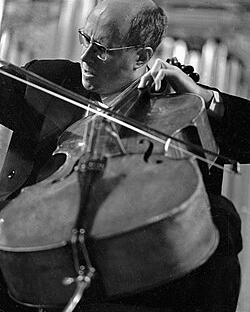
Mstislav Rostropovich
All the same, the humour was distinctly limited: there is little to laugh about in such lawless and arbitrary conduct. This was how the Soviet Union “rid itself” in the 1970s and 1980s of the best, often the most gifted, and certainly the most honest, figures in the worlds of science, scholarship, art and literature.
The Central Committee was informed, for example, that Mstislav Rostropovich and Galina Vishnevskaya (14 March 1978*, 459-A)
“… have been engaged in anti-social activities for the entire period of their time abroad since 1974, denigrating the Soviet State and social system and committing other acts unworthy of the title of Soviet citizen.
“By their provocative actions and defamatory statements Rostropovich and Vishnevskaya have repeatedly provided material for inciting anti-Soviet insinuations in the West, including malicious attacks on the USSR over the notorious issues of ‘human rights’ and ‘creative freedom’ in our country … Such behaviour by Rostropovich and Vishnevskaya creates a precedent for imitation by other politically immature representatives of the creative intelligentsia. Following their example, several musicians, directors, writers, artists and sportsmen have already submitted applications for extended visits abroad.
“In view of the above we consider it expedient to deprive M.L. Rostropovich and G.I. Vishnevskaya of their Soviet citizenship, and to publish an edict of the Presidium of the USSR Supreme Soviet in the ‘News of the USSR Supreme Soviet’ and a short item about this issue in ‘Izvestiya’.”
The same file, it is curious to relate, contained earlier Central Committee documents about its treatment of Rostropovich. There was the ban on his touring the USSR late in 1977 (R 19 October 1977, 237-A) with the Washington National Symphony Orchestra of which he was then conductor. There was also the following memorandum and proposal (12 May 1977*, 958-A):
“According to information received, the Association of International Gatherings in Contemporary Art intends to hold a ‘Rostropovich Competition for Young Cellists’ in Paris from 27 June to 3 July 1977 and has announced this as one of the events to mark his 50th birthday. Preparations for the competition are being accompanied in the West by a raucous advertising campaign.
“In the present situation, it seems expedient to instruct the USSR Ministry of Culture to inform the cultural bodies of Bulgaria, Hungary, the GDR, Cuba, Mongolia, Poland and the Czechoslovak SSR, that it would be undesirable for representatives of the socialist countries to take part in the above-mentioned competition.”
All these documents were considered in deciding what to do about Rostropovich and Vishnevskaya. The couple had more than sufficient grounds to speak of systematic persecution, not just violations of their human rights. The Politburo organised this persecution and then, taking offence at their reaction, deprived them of their Soviet citizenship. What, one wonders, did its members expect? Gratitude?
As if driven by a self-destructive urge, the Politburo took no account of others. It did not matter how famous someone might be or what honours and awards he had earned, in the USSR or elsewhere: if he would not bend to their wishes, he was thrown out of the country. The sculptor Ernst Neizvestny, Yury Lyubimov, director of the Soviet Union’s most famous theatre, and the renowned film director Andrei Tarkovsky were all driven into exile. Tired of the Party’s supervision, others fled the country or refused to return from trips abroad. They became “traitors” and “turncoats” who could not be mentioned in the Soviet press. Their books were withdrawn from libraries and mention of their names was removed from the encyclopaedias. Suddenly scientists, chess-players, ballet dancers and writers were the main enemies of the regime. Nuclear physicists, whom Stalin preferred to leave alone, were not spared (R 6 November 1978, No 24348):
“The Ministry of Medium Machine Engineering has put forward a proposal that S.M. Polikanov, a senior research associate of the Combined Institute for Nuclear Research, should be deprived of his Soviet medals and orders, his title as Lenin-Prize winner, his doctorate in physical-mathematical sciences and be excluded from among the corresponding members of the USSR Academy of Sciences.
“The reason for this proposal is that S.M. Polikanov has established ties with foreign correspondents and provided them with defamatory materials that are used by the Western press for anti-Soviet purposes. He has also joined a group of individuals, well-known for their anti-social activities, and takes part in their hostile acts …
“A decree of the Central Committee, dated 25 August 1978, gives permission for Polikanov and his family to leave for permanent residence in a capitalist country.”
The only person they did not summon the determination to expel was Andrei Sakharov.
Instead, he was exiled to Gorky, without a court decision, and with no recollection of the “legislation”, invented in 1968 for Yakir, Litvinov and Bogoraz. To prevent Sakharov’s “hostile activities”, “criminal contacts” with citizens from capitalist States, and the resulting damage to the “interests of the Soviet State” the Politburo decided (8 January 1980*, Pb 177/X):
“… to take no other step but to exile Sakharov, Andrei Dmitriyevich, in administrative order, from the city of Moscow to a part of the country that is closed for visits by foreigners. A residential regime is to be established for A.D. Sakharov that excludes contacts with foreigners and anti-social elements, and journeys to other parts of the country without the permission of the appropriate body within the USSR Ministry of Internal Affairs. Monitoring to ensure that Sakharov A.D. observes the established regime is entrusted to the KGB and the Ministry of Internal Affairs.”
Can anyone explain to me why the Soviet regime could do nothing in accordance with the laws it had itself invented?
***
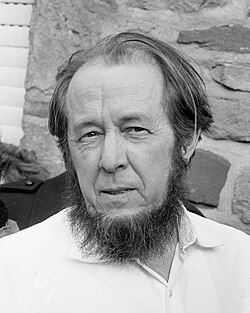
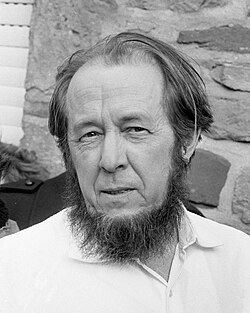
Aleksandr Solzhenitsyn (1918-2008; 1974 photo)
*
4.2
What can we do about Solzhenitsyn?
How the minds of the Politburo worked when resolving such issues is revealed by the minutes of the meeting on 7 January 1974, as they decided what to do about Solzhenitsyn (Russkaya mysl, 30 September & 10 October 1993).
[A brief note has been added on those who were not full, voting members of the Politburo.]
*
7 JANUARY 1974 (POLITBURO)
BREZHNEV. According to reports from our embassies abroad and in the foreign press, a new work by Solzhenitsyn, “The Gulag Archipelago”, is to be published in France and the USA.
Comrade Suslov tells me that the Secretariat has taken a decision to deploy articles in our press, exposing the writings of Solzhenitsyn and bourgeois propaganda linked to the publication of this book. No one has yet read this book but the contents are already known. It is a crude, anti-Soviet lampoon. Today we must discuss what we do next. Our laws give us every right to send Solzhenitsyn to prison because he has offended against all that is most sacred – Lenin, our Soviet system, the Soviet regime, everything that we hold dear.
In the past, we sent Yakir, Litvinov and others to prison; they were convicted and that was an end of it. [Anatoly] Kuznetsov, Alliluyeva and others moved abroad. For a time, it caused a stir, then all was forgotten. Then this delinquent element Solzhenitsyn went on the loose. He takes a swing at everything and shows no respect. What should we do with him? If we penalise him, will that be to our advantage? How will bourgeois propaganda use it against us? I am raising this issue for discussion. I just want us to exchange opinions, talk it over and reach the right decision.
KOSYGIN. We have a note from Comrade Andropov on this matter. It contains the suggestion that Solzhenitsyn be deported from the country.
BREZHNEV. I have talked with Comrade Andropov on this issue.
ANDROPOV. I consider Solzhenitsyn should be deported from the country without his consent. In an earlier period, Trotsky was deported from the country, without asking his consent.
BREZHNEV. Obviously, Solzhenitsyn himself will not agree to that.
KIRILENKO. He can be removed without his agreement.
PODGORNY. Can a country be found that will take him without his consent?
BREZHNEV. Remember that Solzhenitsyn did not go abroad even to receive the Nobel Prize [in 1972].
ANDROPOV. When it was suggested that he go abroad to receive the Nobel Prize, he asked for guarantees that he could return to the USSR.
I have been raising the problem of Solzhenitsyn since 1965, comrades. He has now reached a new level in his hostile activities. He is trying to create an organisation within the Soviet Union, made up of former prisoners. He is speaking out against Lenin, against the October Revolution, and against the socialist system. His composition “The Gulag Archipelago” is not a work of art but a political document. That is dangerous. There are tens of thousands of Vlasovites [Soviet POWs], members of OUN [Organisation of Ukrainian Nationalists] and other hostile elements within the country: hundreds and thousands of people among whom Solzhenitsyn will find support. Now everyone is watching to see how we deal with Solzhenitsyn, whether we take legal measures against him or leave him in peace.
Comrade Keldysh [president of USSR Academy of Sciences] recently rang me and asked why we are not taking any measures against Sakharov. If we do nothing about Sakharov, he says, then Academicians like Kapitza, Engelgardt and others will start behaving the same way.
This is all very important, comrades, and we must resolve these issues, even though the European Conference is now under way [CSCE] I think we must put Solzhenitsyn on trial and apply the Soviet laws to him. Many foreign correspondents and other dissatisfied people are coming to visit Solzhenitsyn. He talks to them and even holds press conferences. There might be a hostile underground organisation in the USSR that the KGB has overlooked. Solzhenitsyn, however, is acting openly and brazenly. He exploits the humane attitude of the Soviet regime and conducts his hostile work with impunity. Therefore, we must take all the measures of which I wrote to the Central Committee, and deport Solzhenitsyn. First, we shall ask our ambassadors to sound out the governments of the countries where they are serving to see if they can take him. If we do not deport him today, he will continue his hostile activities. You know that he wrote a hostile novel “August 1914”, the lampoon “Gulag Archipelago” and now he is writing “October 1917”, a new anti-Soviet composition.
Therefore, I propose that we deport Solzhenitsyn by administrative order. Let us instruct our ambassadors to make the necessary enquiries about receiving Solzhenitsyn in the countries named in my memorandum. If we do not take these measures, all our propaganda work will have no effect. If we place articles in the press and talk about him on the radio, but take no measures that will be just words. We must decide how we are going to deal with Solzhenitsyn.
BREZHNEV. What if we deported him to a socialist country?
ANDROPOV. It’s unlikely, Leonid Ilych, that socialist countries will be receptive. We would be making a gift of such an unwelcome character. Perhaps, we could ask Iraq, Switzerland or some other country? He can live comfortably abroad, he has 8 million roubles in European banks.
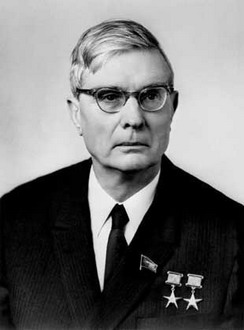
Mikhail Suslov
SUSLOV. Solzhenitsyn has grown insolent. He has insulted the Soviet system and the Communist Party, and raised his hand against the Holy of Holies, against Lenin.
It’s a question of time, how we deal with Solzhenitsyn: whether we deport him, or try him according to our Soviet laws, something must be done. To implement one measure or another against Solzhenitsyn, we must prepare our people and that must be done by deploying wide propaganda. We acted correctly towards Sakharov when we carried out the necessary propaganda work. There are no more bad-tempered letters about Sakharov. Millions of Soviet people listen to the radio and hear broadcast about these new compositions [by Solzhenitsyn]. This all has an effect on the people. We must issue a series of articles and expose Solzhenitsyn. That most certainly must be done.
In accordance with the decision taken by the Secretariat, it is intended to publish one or two articles in “Pravda” and “Literaturnaya gazeta”. The people will learn about this book by Solzhenitsyn. Of course, we must not start a campaign about it but print several articles.
KIRILENKO. That will only draw attention to Solzhenitsyn.
SUSLOV. But we cannot keep quiet.
GROMYKO. Solzhenitsyn is an enemy and I shall vote for the most severe measures against him. As concerns propaganda measures, these should be on the right scale. They require careful forethought.
Neither, however, can we reject the steps proposed by Comrade Andropov. If we deport him by force, against his will, we must be aware that this could turn bourgeois propaganda against us. It would be good to expel him with his agreement, but he will not give his consent. Perhaps, we should be patient for a little while longer, whilst the European Conference is still under way? If some country did agree it would not be expedient to expel him now because this might lead to a wide propaganda campaign against us, and that will not help us when the European Conference comes to an end. I suggest waiting 3-4 months but, let me repeat, in principle I favour severe measures. Solzhenitsyn should now be cordoned off so that he is isolated for those months, and cannot receive people through whom he can wage his propaganda.
Leonid Ilych [Brezhnev] will be making a visit to Cuba in the near future. This is also not entirely favourable to us because it will be hindered by many kinds of material against the Soviet Union. We must take the necessary propaganda measures within the country to expose Solzhenitsyn.
USTINOV. I think we should begin work on the proposals made by Comrade Andropov. At the same time, we must publish propaganda materials exposing Solzhenitsyn.
PODGORNY. I would like to pose the question as follows. What administrative measure are we to take towards Solzhenitsyn: are we to convict him under Soviet law and make him serve his sentence here, or, as Comrade Andropov proposes, are we to deport him?
It is beyond doubt that Solzhenitsyn is an insolent and vehement foe, who is leading the turncoats behind him. Everything he is doing goes unpunished, and that’s also clear to all of us. Let’s see which measure will be most advantageous to us: a trial or deportation. In many countries, in China, they hold public executions; in Chile, the fascist regime shoots and tortures people; in Ireland, the English take repressive measures against the working people. Meanwhile we are faced by a vehement foe and look the other way, when everyone and everything is being smeared with filth.
I consider our law humane but, at the same time, merciless towards enemies, and we should try Solzhenitsyn according to our laws in our Soviet court and make him serve his sentence in the Soviet Union.
DEMICHEV [Central Committee Secretary, Politburo Candidate Member; future Minister of Culture]. Of course, there will be a fuss abroad but we have already published several items about Solzhenitsyn’s new book. We must further expand our propaganda work. We cannot remain silent.
If Solzhenitsyn said in his “Feast of the Victors” that he wrote such things because he is infuriated by the Soviet regime, he is still more insolent and open in his opposition to the Soviet system and the Party in “The Gulag Archipelago”, which he wrote in 1965. Therefore, we must offer sharply-worded articles in our press. In my view, this will not affect the relaxation of international tension or the European Conference.
SUSLOV. Party organisations are waiting, and the socialist countries are also waiting, to see how we react to Solzhenitsyn’s actions. The bourgeois press is now promoting this book of Solzhenitsyn as loudly as it can. We must not remain silent.
KATUSHEV [Central Committee Secretary]. We all share the same assessment of Solzhenitsyn’s actions. This is an enemy and we must treat him accordingly. Evidently, we cannot avoid resolving the problem of Solzhenitsyn now. However, we must find a comprehensive solution.
On the one hand, we shall use all our propaganda against Solzhenitsyn and, on the other, we must take measures in accordance with Comrade Andropov’s memorandum. Obviously, we can deport him with a decree from the Supreme Soviet and announce it in the press. He has assaulted our sovereignty, attacked our freedoms and our laws, and he must be punished for doing so. Negotiations about Solzhenitsyn’s deportation, obviously, will take 3-4 months.
However, I repeat, we must find a comprehensive solution and the sooner we deport him, the better. As concerns our press, we must issue articles.
KAPITONOV [Central Committee Secretary]. I would like to pose this issue as follows: if we deport Solzhenitsyn, what will our people think? They may respond, of course, without any reservations, gossip and so on.
What are we showing by this action: our strength or our weakness? I think that, no matter what, we shall not be demonstrating our strength. So far, we have not yet exposed him ideologically and have told the people nothing about Solzhenitsyn. Yet that must be done. We must begin our work, first and foremost, by exposing Solzhenitsyn, turning him inside out, and then any administrative measure will be understood by our people.
SOLOMENTSEV [Politburo Candidate member]. Solzhenitsyn is a hardened enemy of the Soviet Union. If it was not for the current foreign policy operations of the Soviet Union we could solve the problem, of course, without delay. How will one decision or another reflect on our foreign policy operations? In any case, obviously, we must say everything that should be said to our people about Solzhenitsyn. We must give a critical assessment of his actions and his hostile activities. Of course, the people will ask, Why are no measures being taken against Solzhenitsyn? In the GDR, for example, they have already printed an article about Solzhenitsyn, and in Czechoslovakia as well. I say nothing about the bourgeois countries, but our press is silent. Over the radio, we hear a great deal about Solzhenitsyn and his “Gulag Archipelago”, but our radio keeps quiet and says nothing.
I believe that we should not be silent. The people expect decisive action. Critical material exposing Solzhenitsyn should be printed in our press. Obviously, we should reach agreement with the socialist countries and the communist parties of capitalist countries about propaganda measures that they might take in their countries.
I think Solzhenitsyn should be convicted according to our laws.
GRISHIN. Comrade Andropov, obviously, needs to find a country that would agree to accept Solzhenitsyn. As concerns the exposure of Solzhenitsyn, that should begin without delay.
KIRILENKO. Whenever we talk about Solzhenitsyn as an anti-Sovietist and a malicious enemy of the Soviet system this always coincides with some other important events and we defer a solution to the problem. In the past this was justified, but now we cannot postpone a decision on this issue.
What has been written about Solzhenitsyn is good but, as comrades have already said here, it must be more soundly and critically expressed and argued. For instance, the Polish writer Krolikowski has written a very good exposé of Solzhenitsyn. Solzhenitsyn is becoming more and more insolent. He is not alone but is in contact with Sakharov. Abroad he has contacts with the NTS. Therefore, the moment has come to grapple seriously with Solzhenitsyn and then deport him or take other administrative measures against him.
Andrei Andreyevich [Gromyko] is concerned that this measure might rebound on us. However that may be, the problem cannot be left as it is. Enemies are hampering us and we cannot keep silent about it. Even bourgeois newspapers are now writing that Solzhenitsyn will be tried under Soviet law and has already violated the copyright convention which we have joined.
I support Comrade Andropov’s proposal.
Articles should be provided in the newspapers but very well argued and detailed.
KOSYGIN. We share a common opinion, comrades, and I fully support what has been said.
For several years, Solzhenitsyn has been trying to win over the minds of our people. For some reason, we are afraid to touch him and yet the people would welcome all our actions regarding Solzhenitsyn.
If we speak about public opinion abroad we should consider what will do least harm: to expose him, convict him and send him to prison or to wait several months and then deport him to another country.
I think that we shall face the least costs if we act decisively towards him now and convict him according to Soviet laws.
Obviously, articles about Solzhenitsyn must be provided in the press, but they must be serious. Solzhenitsyn has been bought by Western companies and agencies, and he is working for them. The book “Gulag Archipelago” is an out-and-out anti-Soviet work. I talked with Comrade Andropov about this problem. Of course, the socialist countries will not accept Solzhenitsyn. I am in favour of Comrade Andropov trying to sound out capitalist countries to see which of them might take him. On the other hand, we should not be afraid to apply the harsh measures of Soviet justice to Solzhenitsyn. Look at Britain. They are killing hundreds of people. Or Chile, it’s the same thing.
We must put Solzhenitsyn on trial and tell everyone about him, and then he can be sent to Verkhoyansk to serve his sentence. No foreign correspondent will travel there: it’s too cold. We have nothing to hide from the people. Articles must be published in the newspapers.
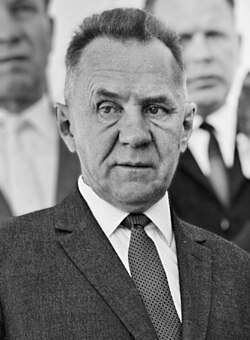
Alexei Kosygin
PODGORNY. Solzhenitsyn is actively carrying out anti-Soviet work. In the past, we deported or put on trial less dangerous enemies than Solzhenitsyn yet we still cannot approach him, we keep looking for a way to do so. Solzhenitsyn’s last book gives no excuse for any concessions.
It is necessary that this measure, of course, does not harm other operations. Solzhenitsyn has quite a few followers but we cannot ignore his actions.
I believe that the people will support any action we take. Articles should be published in the newspapers, but they should be very well argued and convincing. Many know about him and about the latest book. The Voice of America, Free Europe and other radio stations are transmitting broadcasts about him. At home and abroad people are waiting to see what measures the Soviet government takes against Solzhenitsyn. He is not afraid, of course, and assumes that nothing will happen to him.
Despite the European Conference I believe we cannot back down and take no measures against him. Although the European Conference is taking place we must put Solzhenitsyn on trial and let everyone know that we are following a principled policy in this respect. We shall show our enemies no mercy.
We shall do great damage to our cause if we do not take measures against Solzhenitsyn, although there will be an outcry abroad. There will be all kinds of talk, of course, but the interests of our people, and the interests of our Soviet State and our Party come before everything else. If we do not take these decisive measures, we shall be asked why we are not doing so.
I am in favour of putting Solzhenitsyn on trial. If we deport him this will show our weakness. We must prepare for a trial, expose Solzhenitsyn in the press, bring charges against him, conduct an investigation and transfer the case, via the Procuracy, to the courts.
POLYANSKY. Can he be arrested before the trial?
ANDROPOV. He can. I consulted Rudenko.
PODGORNY. As concerns deportation to another country, that’s no good without the country’s agreement.
ANDROPOV. We shall begin working on deportation, but, at the same time, we shall open a criminal case against Solzhenitsyn and isolate him.
PODGORNY. If we deport him he will do us harm abroad.
GROMYKO. We must concentrate, obviously, on the alternative of dealing with him here.
ANDROPOV. If we drag things out with regard to Solzhenitsyn I think that will be worse.
PODGORNY. We can spin out Solzhenitsyn’s case, say, by dragging out the investigation. But let him be held in prison during that time.
Nikolai Podgorny
SHELEPIN. When we met at Comrade Kosygin’s three months ago and discussed what measures should be taken towards Solzhenitsyn, we concluded that administrative measures should not be taken. That was right at the time.
Now a different situation has developed. Solzhenitsyn has openly turned against the Soviet regime and the Soviet State. Now, I believe, it would be advantageous if we resolved the problem of Solzhenitsyn before the end of the European Conference. This will show our consistent and principled approach. If we carry out this operation after the European Conference we shall be accused of being insincere when we reached agreement and that we are now beginning to violate those decisions, etc. We have a clear and correct policy. We do not allow anyone to break our Soviet laws. Deportation to a foreign country is not a suitable measure. In my view, we should not involve foreign States in this matter. We have judicial bodies, let them investigate and then hold a trial.
BREZHNEV. The problem regarding Solzhenitsyn, of course, is not simple but very complex.
The bourgeois press is trying to link the Solzhenitsyn case with the conduct of our major operations to reach peaceful solutions. How shall we deal with Solzhenitsyn? I consider that the best way is to proceed in accordance with our Soviet laws.
ALL. Agreed.
BREZHNEV. Our Procuracy can begin the investigation, draw up the charge sheet, and explain in detail what he is guilty of.
In the past, Solzhenitsyn was imprisoned. He served his sentence for a gross violation of Soviet legislation and was rehabilitated. Yet how was he rehabilitated? He was rehabilitated by two people, Shatunovskaya and Snegov. According to our laws he should be deprived of the opportunity to be in contact with [people] abroad, while the investigation is under way. The investigation must be conducted openly and show the people his hostile, anti-Soviet activities. The people must be shown how he has defiled our Soviet system, slandered the memory of our Great Leader, V.I. Lenin, the founder of the Party and the State, defiled the memory of the victims of the Great Patriotic War [1941-1945], justified counter-revolutionaries, and directly violated our laws.
In the past, we did not fear to confront counter-revolution in Czechoslovakia. We did not fear to let Alliluyeva leave the country. We survived all that and, I think, we will also survive this. We must provide well-argued articles, and give a strict and precise response to the writing of a journalist such as Olson, and publish articles in other newspapers.
I have talked with Comrade Gromyko about the influence our measures towards Solzhenitsyn will have on the European Conference. I do not think it will have a great influence. Obviously, it is not expedient to deport him because no one will accept him. When [Anatoly] Kuznetsov and others fled the country, that’s one thing; it’s another matter when we are deporting someone as an administrative measure.
Therefore, I consider it necessary to instruct the KGB and the USSR Procurator-General’s office to draw the procedure for bringing Solzhenitsyn to trial and, considering everything said at this Politburo meeting, to adopt the appropriate judicial measures.
PODGORNY. He should be arrested and charged.
BREZHNEV. Let Comrades Andropov and Rudenko draw up the procedure for charging him, keeping everything in accordance with our legislation. Comrades Andropov, Demichev and Katushev must be instructed to prepare information for the secretaries of the fraternal Communist and Workers’ Parties in the socialist countries and other leaders of fraternal Communist Parties about our measures towards Solzhenitsyn.
ALL.Agreed.
The following decree has been adopted:
On measures to halt the anti-Soviet activities of Solzhenitsyn, A.I.
“For malicious anti-Soviet activities, as expressed by the transfer to foreign publishers and information agencies of manuscripts, books, letters and interviews: that slander the Soviet system, the Soviet Union, the Communist Party of the Soviet Union, and their foreign and domestic policies; that defile the radiant memory of V.I. Lenin and other leaders of the CPSU and Soviet State, and the victims of the Great Patriotic War and the German-fascist occupation; that justify the actions both of internal and of foreign counter-revolutionary and elements and groups hostile to the Soviet system; and also for gross violation of the rules for publishing literary works in foreign publishing houses, laid down by the World (Geneva) Copyright Convention, Solzhenitsyn A.I. is to stand trial.
“Instruct Comrades Andropov and Rudenko to determine the order and procedure for conducting the investigation and the trial of Solzhenitsyn, in accordance with the exchange of opinion at the Politburo, and to submit their suggestions on this matter to the Central Committee.
“Instruct Comrades Andropov, Demichev and Katushev to prepare information for the first secretaries of the Central Committees of Communist and Workers’ Parties of the socialist and certain capitalist countries about the measures we are taking with regard to Solzhenitsyn, bearing in mind the exchange of opinions at the Politburo, and present this information to the Central Committee.
“Instruct the Secretariat to determine the deadline for sending this information to the fraternal parties.”
xxx
The Soviet leaders, as we can see, were not at all concerned about legality and if they did recall the law then it was only in reference to its “harsh” implementation. They sincerely believed, one gains the impression, that whatever they decided would be lawful.
Not one of them suspected, for example, that by law only the Procuracy could instigate criminal proceedings while the “procedure for the conduct of the pre-trial investigation and the judicial process” was laid down in the RSFSR Criminal-Procedural Code. Neither the head of the KGB nor the Procurator-General could decide how interrogations and court hearings were to be conducted. Yet what did the law matter when the members of the Politburo had a defective relationship with reality? Just consider their conviction that “hundreds of workers are being killed in England”; the assertion that they “had not been afraid to let Alliluyeva leave the country”; not forgetting their quite unfounded certainty that ordinary people in the USSR supported their repressive measures.
The Western press was then full of Sovietologists’ discussions about a conflict between “doves” and “hawks” within the Politburo. Worse still, Western politicians believed these myths: detente, the most idiotic period in post-war history, was in the ascendant. Yet from the minutes quoted above it is easy to see that the only “dove” in the leadership was Andropov, and it was not the kindness of his heart that made him prefer deporting Solzhenitsyn to putting him on trial. It was all very well for the Politburo to decide what others should do. They bore no responsibility for implementing the decision: Andropov knew that the negative consequences of arresting and prosecuting Solzhenitsyn would be laid at his door. Naturally, he found a way of reversing the Politburo decision or, to be more precise, he found a country that would take Solzhenitsyn against the writer’s will.
For Andropov and for Gromyko, to some extent, the Politburo decision to prosecute Solzhenitsyn was extremely unwelcome. The other Soviet leaders did not agree with them and rejected their recommendations. Such a defeat was not a good omen: far more serious, it put all their cunning detente games at risk. What could they do but turn to their Western partners in detente? The German Social Democrats did not let them down.
We shall return to the subject in Chapter Seven (“Betrayal”). Here we may simply note that within a month a solution was found. On 2 February 1974, the West German Chancellor Willy Brandt suddenly announced that Solzhenitsyn could live and work without hindrance in the Federal Republic. As Solzhenitsyn would later write in The Oak and the Calf, “he spoke and it was done”. Andropov reported immediately to the Central Committee (7 February 1974*, 350-A/OV): “This declaration by Brandt gives every justification for deporting Solzhenitsyn to the FRG, after adopting the necessary edict of the Presidium of the USSR Supreme Soviet depriving him of his citizenship. This decision will also be lawful, bearing in mind the existence of materials concerning Solzhenitsyn’s criminal activities.”
To be quite sure of getting his way, Andropov did two more things. He instructed his subordinates Chebrikov and Bobkov to compose a memorandum about popular attitudes towards Solzhenitsyn, implying that the writer had more than a few followers in the USSR among manual workers who believed he was in favour of lowering prices and ending “aid to Cuba and developing countries” so as to increase the well-being of ordinary people. Then Andropov sent a personal letter to Brezhnev to accompany the memorandum (7 February 1974*). The Solzhenitsyn affair, he wrote, was “no longer a criminal matter and had become a considerable problem of a definitely political character” and concluded
“Dear Leonid Ilych,
before sending this letter we at the Committee once again most thoroughly weighed up all the possible costs that could arise (to a lesser degree) from deportation and (to a greater degree) from the arrest of Solzhenitsyn. There will indeed be such costs.
Unfortunately, however, we have no alternative since letting Solzhenitsyn’s behaviour go unpunished is already causing us much greater costs within the country than those which will arise in international terms if Solzhenitsyn is deported or arrested.”
Andropov, in short, got what he wanted and, of course, he was right. The costs to the USSR of deporting the writer were far fewer. This is why that form of political reprisal became so common by the end of the 1970s.
*
This raises another question, however, about the internal costs of the “unpunished behaviour” of any one of us and, note well, no one in the Politburo disputed that these were greater than the other costs to the regime. The high value placed on the effectiveness of our activities is intriguing and explains a great deal.
The system could survive only by sustaining the Party’s monopoly of power, and the precedence of ideology over law, logic and common sense. That, evidently, was what one of the Politburo members meant when he talked, in their discussion of Solzhenitsyn, about a violation of their “sovereignty”. They had been conscious of such a “violation” since our movement began. As far back as 1968, after the Ginzburg-Galanskov trial, Andropov wrote (R 26 Jan 68, 4 pp – 181-A):
“It has become quite obvious that Western propaganda and a group of the above-mentioned individuals, acting as an instrument in the hands of our adversaries, are trying to make it legal to carry out anti-Soviet work in our country and attain impunity for hostile actions.”
For the KGB chief our emphatically open and legal activities and our appeal to the law were far more dangerous than any underground conspiracy or terrorist act. After the Helsinki Groups emerged in 1976, Andropov warned (15 November 1976*, 2577-A): “In recent years the special services and propaganda bodies of the Adversary are trying to create the semblance in the Soviet Union of an ‘internal opposition’, and are taking measures to support those who inspire anti-social behaviour and objectively aid the consolidation between the participants of various trends in anti-Soviet activity.” Early in 1977, describing measures to obstruct the activities of prominent Helsinki Group activists, Andropov and Procurator-General Rudenko commented (20 January 1977*, 123-A): “Giving priority at the present level to illegal methods of underground work in the pursuit of anti-Soviet goals, the Adversary is also trying to activate hostile actions in legal or semi-legal forms.”
Arrests and deportation were not the only way the regime reacted to these attempts, of course: it deployed the entire arsenal, from incarceration in psychiatric hospital s and smear campaigns (“compromising measures”), to threats and blackmail. In 1977, as we have already seen, the Party tried to cement its control in the new Soviet Constitution, by openly declaring, for the first time, its monopoly on power. Those were the ways they defended their “sovereignty” against our “assaults”, in part accepting the rules of the game we proposed. It cannot be said that the Soviet regime failed to demonstrate flexibility. It was prepared to bear certain costs, but it could not get by without the usual repressive measures (29 December 1975* (3213-A, p. 4):
“At the same time, it is impossible to refrain at present from the prosecution of individuals who are opposed to the Soviet system, since this would lead to an increase in especially serious State crimes and anti-social behaviour”.
That was Andropov, writing in December 1975, when the Helsinki Accords had already been signed. He thereby accepted, as the lesser of two evils, the “external costs” that violations of the agreement would inevitably entail. These costs were significant. For it was not only “bourgeois” public opinion which proved strongly opposed to the USSR – that could have been dismissed as the “intrigues of imperialism”. “Progressive” public opinion was of a similar mind. Western Communist Parties, especially those that were large and therefore more dependent on public opinion within their own countries, had to condemn such practises, though with caveats and against their will. Their words of denunciation may have been only for show. The threat of a split in the communist movement and, yet more worrying, of the USSR’s political isolation, was quite real.
*
4.3: External costs
Naturally, the Politburo was unsettled by such a turn of events.
Andropov began his report (29 December 1975*, 3213-A) by expressing concern about what the leaders of the French and Italian Communist Parties had been saying:
“Recently bourgeois propaganda has been making active use in its subversive activities against the Soviet Union and other socialist countries of the well-known statements by the leaders of the French and Italian Communist Parties on issues concerning Soviet democracy … The problems arising from the statements by certain leaders of the French and Italian Communist Parties, apart from their ideological and theoretical aspect, also have an aspect that concerns the security of the Soviet State. …
“The thesis put forward by ‘Humanité‘ that freedom of action should be afforded under conditions of socialism to those who ‘assert their disagreement with the system devised by the majority’ objectively aids the adversaries of socialism in their attempts to create within the Soviet Union and other socialist countries a legal opposition, and to undermine the leading role of the Communist and Workers’ Parties.”
Drawing, in passing, on a long perspective that included his own involvement in suppressing the 1956 Hungarian Revolution, he continued:
“Comrades who have made such statements, even after the events in Hungary and Czechoslovakia, do not want to see that in conditions of developed socialism, despite the monolithic and political unity of society, anti-Soviet behaviour is still preserved in one form or another, to a greater or lesser degree. … The information we possess testifies that the special services and ideological centres of the Adversary are striving to unite the actions of hostile elements of all shades. … From the above we can see it could provoke the most serious negative consequences if we stopped active obstruction of the politically harmful activities of the ‘dissidents’ and other hostile elements, as the French and Italian comrades wish …
“It would be desirable at a suitable moment to hold relevant high-level discussions with French and Italian comrades during which we shall explain to them that the struggle against the so-called ‘dissidents’ is not an abstract issue concerning democracy, but vitally important for preserving the security of the Soviet State.”
On several occasions the Politburo sent long messages to the leaders of “fraternal parties “.
French Communist Party
The first letter to the French Communist Party (R 18 December 1975, Pb 198-93) adopted a cautious and diplomatic tone:
“Comrades! We understand very well that the PCF is waging a stubborn struggle for democracy in France against the attempts of reaction to assail the rights of working people. This is a lawful struggle and it has our full understanding and support. However, you cannot defend freedom in France and, at the same time, permit frequent attacks on the Soviet Union that harm relations between our parties …
“Of course, in our country, as in others, there are criminal elements whom the Soviet regime is obliged to isolate in places of confinement and re-education through labour. This has nothing in common with the violations of democratic liberties of Soviet people. We can honestly tell you that a numerically insignificant number of individuals among the 250-million strong population of our country are being convicted by the Soviet courts in full conformity with the Constitution, and observing the norms of the judicial democratic process, and only when they are waging hostile activities against the socialist system and the Soviet State.”
A much longer letter to 22 “fraternal parties” (including the PCF) was despatched a month later (R 14 January 1976, Pb 201-44) and contained an extended rebuttal of the “fabrications of anti-Soviet propaganda”. After three weeks, this message was sent to a further 13 Communist parties, not excluding the smallest and those that were operating underground (R 5 February 1976, Pb 203-104).
Later that year diplomacy gave way to irritation and concern. The International Department informed the Central Committee of reports from Soviet ambassadors about a revival of the campaign in support of the dissidents. More worrying were the attempts by the organisers to “involve progressive organisations” in their protests and link them to statements in defence of “the victims of lawless treatment in capitalist countries” (25 October 1976*, 25‑S‑2025):
“In Paris on 21 October a rally was held in support of Bukovsky and, at the same time, of the Uruguayan communist Masser and several other individuals. Representatives of the French Communist Party took part in the rally and, as a result, the Central Committee sent a letter to the PCF leadership (decree No 030/43 of 18 October this year).
“We consider it would be expedient to send guidance on these issues to Soviet ambassadors in those capitalist countries where such attempts may be made (Italy, Great Britain, USA, Japan, Spain, Portugal, Belgium, Switzerland, Sweden and Norway). The text of this telegram to Soviet ambassadors is attached.”
That was not the end of the matter, naturally, and in spring 1977 the Politburo again sent a long message to the PCF, which was much sharper in tone than its predecessors. This time it was not just a letter but a substantial theoretical work, intended to explain to the errant French comrades the class nature of both democracy and human rights. The text took more than a month to compose. It was discussed by the Politburo on several occasions, and underwent further revision before being sent to the PCF in mid-March (15 March 1977*, Pb 49/XV); subsequently it went to all the communist parties in the world, but only in late March, early April. They did not neglect us in this letter as the cause of these theoretical disagreements but in place of the usual derogatory comments we were given a more substantial “class-based” definition (pp.6-10 of March 1977 document):
“The appearance of an insignificant little group of counter-revolutionaries, who have detached themselves from the very foundations of our system and started struggling against that system and who as a rule are linked with imperialist circles, does not in any way represent a logical result of the Soviet Union’s internal development. In the past, as we know, there were groups of individuals and political parties in our country that openly opposed the Soviet system. They frequently moved from words to deeds, even attempting to kill V.I. Lenin and other leaders of the Communist Party and the Soviet government. Then these groups and parties drew support from the exploitative classes which had not yet been eliminated.
“Today there are no such classes in our country and consequently there is no social base for anti-Soviet groups. However, there are individual protests of an anti-Soviet character. This is not surprising. The development of political awareness among the many millions of the popular masses, their upbringing in the spirit of socialist ideology and morality, the transcendence of private-property-owning ideology and spirit, and the elimination of survivals of capitalism in the minds of the people – all these ideological processes, as is well known, proceed far more slowly than the restructuring of society’s material foundations. Moreover, they are proceeding today against a background of sustained, daily, anti-Soviet propaganda and the direct subversive actions of imperialist “centres” which, in recent times, have sharply intensified their level of hostile activity against the countries of socialism. The survivals of capitalism in the minds of certain people are systematically stirred and encouraged from without by imperialist propaganda centres …
“Our class adversaries, in their striving to create the impression that there are many opponents of socialism in the USSR, resort to the most varied tricks. One of the most common is to declare as “dissidents” everyone who on a certain issue has a viewpoint differing from that generally accepted in our country, including writers and actors, for example, who have professional differences of opinion within their creative organisation. The total falsity of this tactic is understood …
“… The close link between the activities of the “dissidents” and the development of the international class struggle can also be seen from the following. The first of the people who spoke out as active opponents of the Soviet system made their appearance in the mid-1960s, i.e. at a period when detente was beginning, and imperialism put forward the slogan that socialism “had mellowed”. The accusations they then made against the Soviet Union and other countries of socialism, which they continue to make today, are the same as were and are used by bourgeois propagandists. Their demands were also similar to Western demands concerning the “mellowing” of socialism. Numerous facts show that this is no coincidence and that in a great many cases the so-called champions of an improved socialism receive materials containing defamatory statements from abroad, from bourgeois intelligence agencies. Whenever any of the “dissidents” find themselves in the West, they quickly discard the false mask of “champions of the improvement of socialism” and turn out to be frankly reactionary, a monarchist (like Solzhenitsyn) or an admirer of Strauss and Thatcher (like Bukovsky), and urge Western leaders to engage in a more active struggle against the Soviet Union and other socialist countries. Many fraternal parties have already taken note of this, including communists in Great Britain, the Netherlands, Austria, Portugal, Greece, Finland and several other countries. Their newspapers write on the subject. It is strange that certain leaders of the PCF remain quiet about it. Moreover, they call on us to give such people “unlimited freedom to express their opinions” and to hold “discussions” with them!”
In the main, however, this message was not about us but about the French Communist Party and the position it had adopted. The opening pages of the letter almost took the form of an ultimatum, and came near to declaring a complete breakdown in relations:
“The latest statements in a number of interviews, and in anti-Soviet broadcasts on French television, show that some of the PCF leadership have passed from criticism of individual aspects of socialist democracy in the Soviet Union and other socialist countries to attempts to raise doubts about whether the political system in the USSR and other socialist countries reflects the interests of the people. It is openly and publicly suggested that we either reconsider or, in essence, reject the entire system of Soviet democracy in order to give unlimited “freedoms” to all opponents of socialism …”
This was not open for discussion. Anyone who persisted was an enemy of the USSR.