KGB REPORT to the Central Committee (Politburo) by Vladimir KRYUCHKOV, new KGB head (1988-1991) on Andrei SAKHAROV’s funeral [R: 20 Dec 89, 3 pp. 2568-K]. 3 pp.
=============================
[page one of three]
kb-4 [two illegible words] DISTRIBUTED No. 1658.
Secret
‘177‘ Copy No. 2.
20 December 1989, No. 2568-K.
To the CPSU Central Committee
[STAMP: “Declassified:
(illegible) Russian Federation. signed, 1994“]
Mourning Events linked to the Death of A[ndrei] Sakharov
On 18 December of this year mourning events linked to the death of Academician A. D. Sakharov were completed.
After bidding farewell to him in the building of the presidium of the USSR Academy of Sciences and the Lebedev Physics Institute (USSR Academy of Sciences), the mourning procession made its way to the Luzhniki Sports Complex. During the final stage the bus with the deceased’s coffin was accompanied by about 20,000 people. A group among them, formed earlier from representatives of a number of civic associations, carried the Russian, Ukrainian, Moldovan and Latvian national flags: they also bore placards with such inscriptions as “You were the light of the world in the dark kingdom in the midst of an aggressive and obedient majority”, “… even in death you frighten them …”, and others.
Approximately 40,000 people, including about three hundred USSR People’s Deputies, took part in the civil funeral rites, which began at 2 pm in Luzhniki. Twenty-six people gave speeches: 14 USSR People’s Deputies; Deputy Prime Minister of Italy, Martelli; Senator Romaszewski of the Polish Sejm [parliament]; Metropolitan [Russian Orthodox Church] Pitirim [1]; Father Gleb Yakunin [2]; and representatives of civic associations.
In their speeches they noted Sakharov’s services to the international community, /…
—————————————————
[page two of three]
his unflagging struggle for human rights, and expressed their support for his activities. Individual speakers sought in essence to canonize the late Academician, to turn him into a distinctive symbol of the struggle to create groupings opposed to the CPSU.
Murashov, a member of an Inter-Regional Group [3] of deputies, declared that, in fulfilling Sakharov’s behests, the group is ready to declare itself a parliamentary opposition. USSR People’s Deputy Yu. N. Afanasyev harshly criticized the work of the 2nd Congress [4] and appealed for “the unification in a single democratic bloc named after Sakharov.” “[A] decisive battle with the Stalinist-Brezhnevite proteges still lies ahead,” asserted Major Moskovchenko, a representative of the coordinating council of the Shchit [Shield] Association.
After the official end of the civil funeral rites at 4 pm a large number of participants left the site; for 40 more minutes, however, the functionaries of informal associations tried to hold an unofficial meeting of a provocative character.
For a period of 30 minutes after 5 pm a ceremony to bid farewell to the deceased took place at the entrance to Vostriakovsky Cemetery. Among its participants were [Lech] Walesa, leader of Polish “Solidarity”; [Jack] Matlock, the US Ambassador in Moscow [1987-1991]; other representatives of the diplomatic corps; foreign correspondents; as well as members of Inter-Regional Groups of deputies.
After the burial a commemorative evening took place at the restaurant of the Hotel Russia (seating for 510).
The mourning events showed that the calculations of specific circles to use them for speculative political purposes have not been justified.
————————————————-
[page three of three]
As noted, they failed to attract hundreds of thousands of people; for that reason all the mourning events were deliberately dragged out, attempts were undertaken to ensure the participation in the funeral of as large a number of people as possible, especially students.
Neither was there any mass support for appeals to launch mass actions, work stoppages at enterprises and institutions, and naming streets, squares, and populated areas in honor of Sakharov.
This is reported as information.
Chairman of the Committee
(signature) Vladimir Kryuchkov
========================================
NOTES (JC)
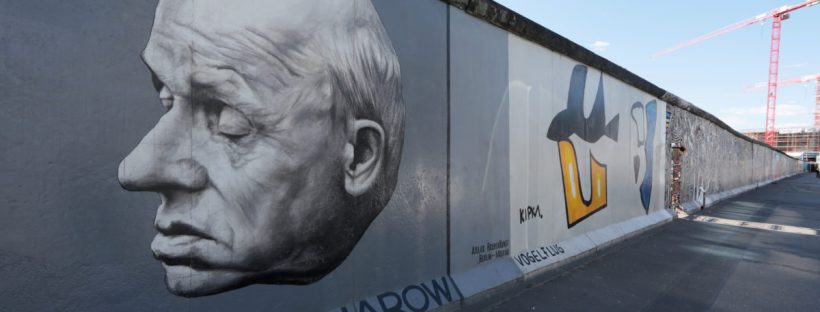
The feature photo is a depiction of Sakharov on the Berlin Wall.
*
- Until 1990 when the new Patriarch Alexy II was appointed to head the church, Pitirim was the most prominent leader of the officially supported Russian Orthodox Church. He was in no sense a supporter of Sakharov or the dissident movement.
↩︎ - Orthodox priest Gleb Yakunin, arrested on 1 November 1979 (CCE 54.1-2) and tried and convicted, was a key figure in the dissident movement. He was released in March 1987.
In 1976, together with Kapitanchuk and other Orthodox Christian activists, he set up the Committee for the Defence of Christian Rights in the USSR. An ecumenical body, the Christian Committee worked with Catholics (in Lithuania and elsewhere) and with unregistered Baptists and Adventists. At one point, it spoke out in defence of the right of Jewish activist Josif Begun to practise his religion in captivity.
↩︎ - The Inter-Regional Grouping, led by Sakharov, Afanasyev, Moscow Mayor Gavriil Popov and Boris Yeltsin, constituted the opposition at the new USSR Congress of People’s Deputies.
It was formed after that quasi-democratic body (cf. 1848 National Assembly in Germany) held its first session, 25 May-9 June 1989. The IRG, says Wikipedia, was “the first Soviet legal parliamentary opposition”.
↩︎ - Yury Afanasyev, rector of the Moscow Historical Archives Institute (1986-1991), was a leader of the Inter-Regional Group of Soviet People’s Deputies (and later of Democratic Russia).
He coined the term “submissive-aggressive majority” to describe most of the other deputies at the new Congress, which next assembled in October 1989.
↩︎
*
General
Translator’s and editors notes are bracketed [].
translated by Marta Olynyk (2010);
verified and annotated, John Crowfoot
=================================
 The Bukovsky Archives